Reports: Reviewing the Day
Goal: Use the Reports screen to review what happened today: which signals fired, which triggers carry a real backtest edge, which runners are open, and how the day’s confluence broke down.
You need: A Squeeze Setups account ($99/mo), and a few minutes after the close. Reports is read-only, so there is nothing to set up.
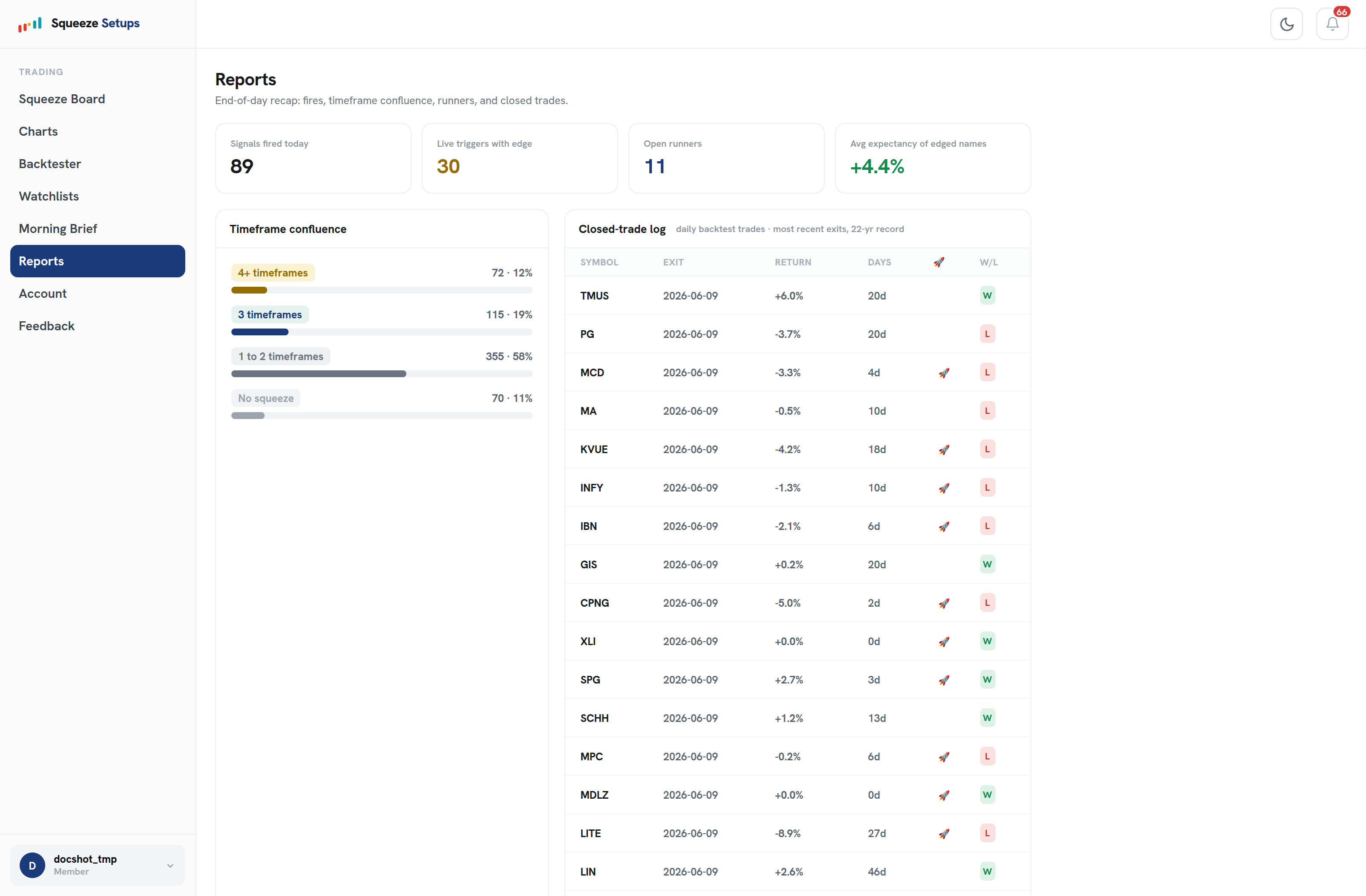
Reports is the end-of-day recap. The Morning Brief tells you what to watch before the open; Reports tells you what actually happened after the close. It is one dated page: a row of stat cards across the top, a timeframe-confluence breakdown in the middle, and a closed-trade log at the bottom. Read it once a day and you will know whether the day produced anything worth acting on tomorrow.
What do the stat cards tell me?
The cards across the top are the day in four numbers. Read them left to right before you scroll.
- Signals fired today. How many triggers fired across the universe today, counting both a gold Slingshot Squeeze arrow and a cyan Squeeze Signal arrow. This is raw activity, not quality. A big number on a quiet tape usually means a lot of low-timeframe noise.
- Live triggers with edge. The subset that fired on a name with a positive per-symbol 22-year record. This is the card that matters most. A signal without a backtest edge behind it is close to a coin flip; remember a bare squeeze entry won only about 53.9%, no better than a random day at 53.7%. The edge is what separated our daily Slingshot Squeeze (69.1% win) from that baseline.
- Open runners. Names that triggered and then ran without pulling back. These are worth a second look: across our long sample, about 46% of signals never pulled back a full ATR, and those runners won roughly 92%. An open runner is a position the market is carrying for you, not a fresh entry.
- Average expectancy of edged names. The mean expectancy per trade across today’s edged triggers, in percent. It tells you, in one figure, how good the day’s qualified setups were on paper. For context, daily Slingshot Squeeze averaged +0.93% per trade over 22 years; a day’s average near that is a strong day, well below it is a thin one.
Scan “signals fired today” for activity, then look at “live triggers with edge.” A day can fire fifty signals and produce three you would actually take.
How do I read the timeframe-confluence breakdown?
Below the cards, the day’s firing names are bucketed by how many shown timeframes were in a squeeze at the same time. Confluence is the second of our three pillars (backtest edge, timeframe confluence, trend stack), and this breakdown is where you see it for the whole day at once.
| Bucket | What it means | How to treat it |
|---|---|---|
| 4+ | Four or more timeframes compressed together | Highest agreement. These belong at the top of tomorrow’s list. |
| 3 | Three timeframes lined up | Strong, still worth attention. |
| 1-2 | Only one or two timeframes in a squeeze | Thin. Lean on the backtest edge before trusting it. |
| none | Fired with no broader confluence | Mostly noise. Skip unless the per-symbol record is exceptional. |
Confluence and edge work together. A 4+ name with a positive 22-year record is the cleanest thing the day produced. A “none” name with no edge is the kind of signal the board exists to filter out, not toward.
What is in the closed-trade log?
The bottom of the page is the closed-trade log: every backtest-tracked trade that exited today. Remember the rule for both setups, the green fire is the exit, not the entry, so a close here means a tracked trigger reached its fire. The log is how you keep the record honest after the fact.
Use it two ways.
- As a reality check. It shows wins and losses side by side, and on our daily numbers one trade in three still lost. Seeing the losers listed plainly keeps you from remembering only the wins.
- As a tomorrow filter. A name that just closed a clean win and is tightening again is a different proposition than one that just closed a loss. The log gives you the recent context the Morning Brief will not.
How does Reports fit the daily routine?
Reports is the closing bookend of the day. The flow is simple: read the Morning Brief before the open to set your watch list, work the board live during the session, then read Reports after the close to score the day and seed tomorrow’s attention. The “live triggers with edge” and “4+” confluence names are the natural carryover into tomorrow’s watchlist.
One caution on scope: the daily Slingshot Squeeze and daily Squeeze Signal are the validated, daily-only edges. The intraday Squeeze Signal backtest is still in progress, so treat intraday signal counts on this page as activity to watch, not as a settled edge. When in doubt, click through to a name’s Backtester to see its full 22-year record before you act.
Squeeze Setups is an educational research tool, not financial advice.
Related: The Daily Routine, Morning Brief, The Runner Finding