Squeeze Fired: What It Means and What to Do
Key takeaways
- “Fired” means the squeeze has released: the Bollinger Bands have expanded back outside the Keltner Channels and the stored energy is moving. On the board it shows as a green dot.
- The fire is the exit, not the entry. By the time you see green, the move you wanted to be early for has already begun.
- If you are already in a position from a Slingshot Squeeze or Squeeze Signal trigger, the fire is your cue to manage or exit. If you are flat, it is not a fresh signal.
- Our backtests measure the entry on the trigger while the squeeze is still on, never on the green dot.
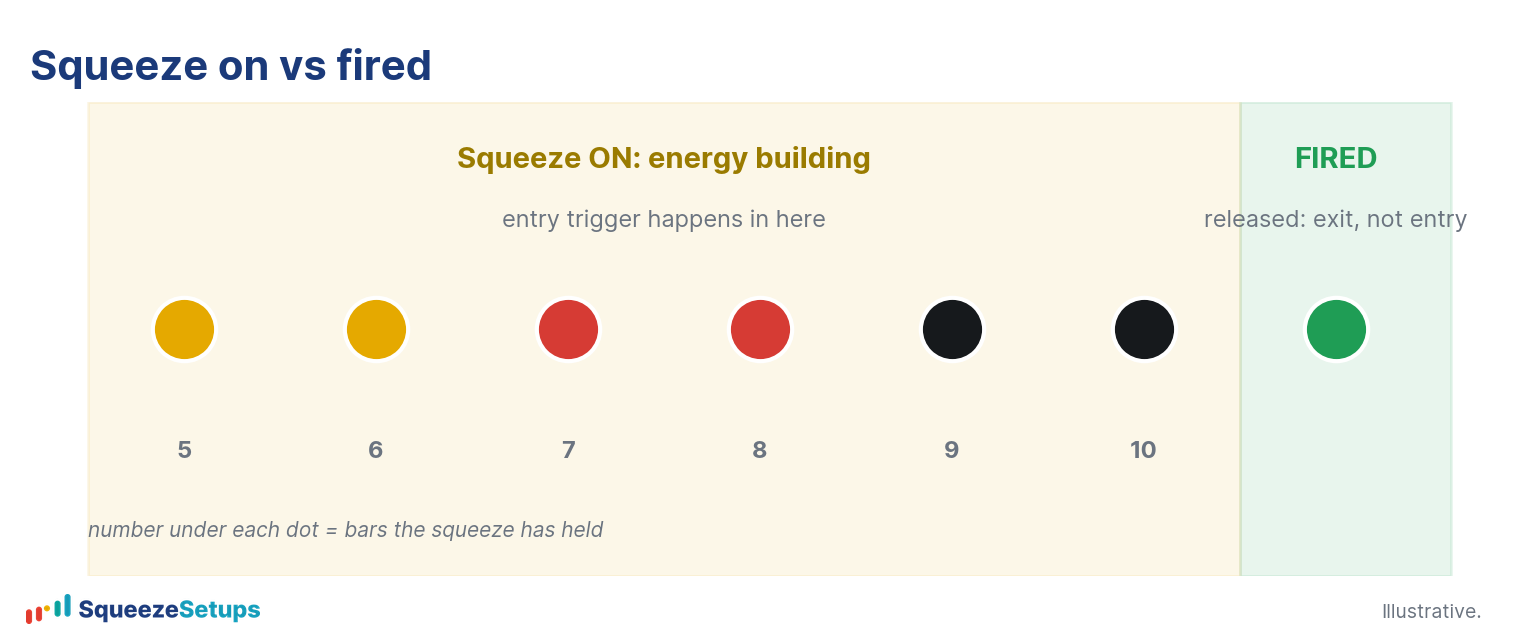
A “fired” squeeze means the compression is over and price is releasing. A squeeze exists when the Bollinger Bands sit inside the Keltner Channels, which says volatility has tightened and energy is being stored. When the bands expand back outside the Keltrels, that compression breaks: the squeeze fires. On the Squeeze Board this moment is the green dot, the tier our live legend labels Fired. The green dot marks the end of the setup, not the start of one.
What does “fired” actually mean?
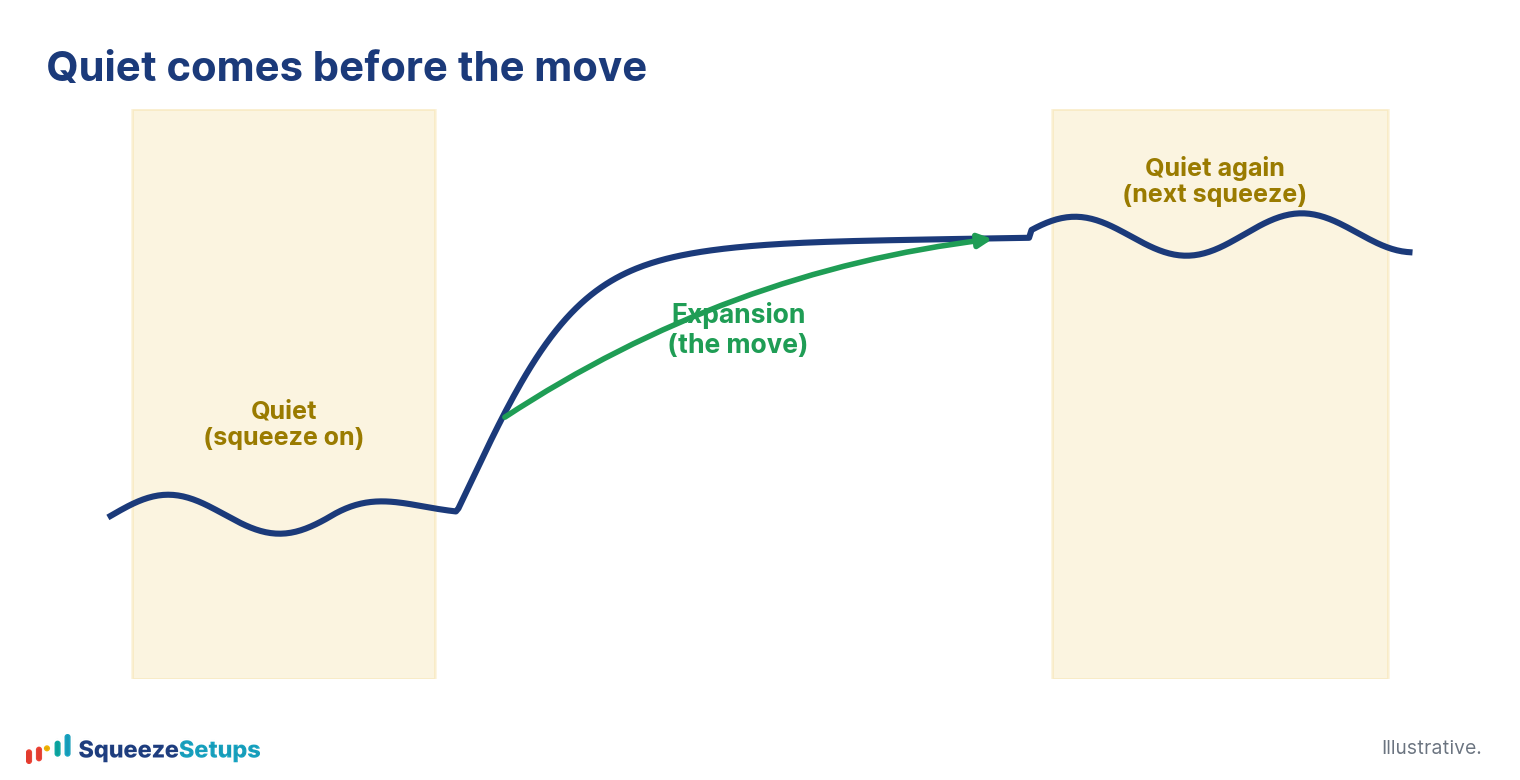
Throughout a squeeze, volatility is contracting. The Bollinger Bands, which track recent price range, narrow until they slip inside the Keltner Channels, which track a smoother volatility envelope. That nesting is the squeeze. It does not tell you direction; it tells you that the market has gone quiet and pressure is building. Bars in the squeeze accumulate, and on the board the number printed on each dot counts them.
Firing is the release. The bands widen, push back outside the Keltner Channels, and price starts to travel. The dot turns green. That is the entire mechanical meaning of “fired”: compression in, expansion out. It is a statement about volatility, not a buy or sell instruction on its own.
Why the green dot is the exit, not the entry
Traders get this backwards often. It feels natural to wait for confirmation, see the green dot, and buy. But the green dot is confirmation that the move you wanted to catch early has already started. The squeeze was the loaded spring; firing is the spring already extending. Entering on green means entering late, after the easy part of the release.
That is why both of our validated setups enter while the squeeze is still on. A Slingshot Squeeze triggers when momentum turns up from below zero with the squeeze still nested, in a stacked uptrend, with Edge Signal confirmation. A Squeeze Signal is a continuation: momentum is already above zero and the compression tightens another tier. In both cases you take the trigger during the squeeze, and the green fire is the signal to be done, not to begin.
What to do when you see a squeeze fire
What you do depends entirely on whether you are already in the trade.
| Your situation | What “fired” means for you | Action |
|---|---|---|
| In a position from a Slingshot or Squeeze Signal trigger | The setup has played out; the release is underway | Manage the position or take the exit your plan calls for |
| Flat, no position | The early, compressed entry has already passed | Do not treat the green dot as a fresh entry; wait for the next setup |
| Watching a name still in a squeeze (not green) | Energy is still stored, no trigger yet | Watch for a trigger arrow while the squeeze stays on |
On the board, the practical reads line up with this. A gold arrow marks a Slingshot Squeeze, a cyan arrow marks a Squeeze Signal, and the Status column tells you where a name sits: “in squeeze”, “FIRED”, or a runner chip. When you see FIRED on a row you are not holding, treat it as information, not a fresh entry.
One important exception: the runners
Not every fire is a clean exit cue, and the data says so. In our long backtests:
- About 46% of signals never pulled back a full 1 ATR after the trigger.
- Those runners won roughly 92% of the time, and that figure held across all five eras we tested.
- The average adverse excursion across signals was about 1.6 ATR.
A meaningful share of these moves keep going without giving you a clear place to add or re-enter, and they tend to be the best ones.
So firing is not a blanket “sell now.” It is the moment to switch from setup logic to management logic. Whether you trail, scale, or close is a position-management decision your own plan should answer. What firing changes is that you are no longer waiting on a squeeze; you are managing a release.
Where the edge actually lives
The entry timing is where the difference shows up. Compare the win rates:
- Bare squeeze entry: about 53.9%, roughly the same as picking a random day at 53.7%.
- Buying the first green dot: about 54.8%, a little better but still close to even.
- Daily Slingshot Squeeze: 69.1% over 5,852 trades.
- Daily Squeeze Signal: 67.4% over 4,496 trades.
The edge does not come from the squeeze firing. It comes from entering on a confirmed trigger, in a stacked trend, on a name with a positive 22-year record. Both setups were measured on the trigger entry, with the green fire treated as the exit, not the buy.
The gap between 54.8% and 69.1% is what matters. The green dot is real and useful, but it marks the close of the opportunity. Treat it as the end of the on/exit model, manage what you hold, and let the next squeeze build before you act again. And remember that one trade in three still lost; these are historical backtests before commissions and slippage, never a forecast.
Please note: This research is based on historical backtest data. It is NOT a prediction, and it is NOT financial advice.
Related: The green dot is the exit, not the entry, How a squeeze fires, What is the squeeze?