The Daily Routine: Scan, Board, Qualify, Enter, Manage
Goal: Run one repeatable flow each morning that turns the whole platform into a single decision: scan, board, qualify, confirm, enter, manage.
You need: A Squeeze Setups login, ten minutes before the open, and a watchlist you can add to as names surface.
The screens are not separate tools. The Morning Brief tells you where to look, the Board ranks what is there, the drawer qualifies one name, Charts confirms it, and the trigger tells you when to act. Below is the same six-step routine we run, in order, with the exact screen for each step.
Step 1: Scan the Morning Brief
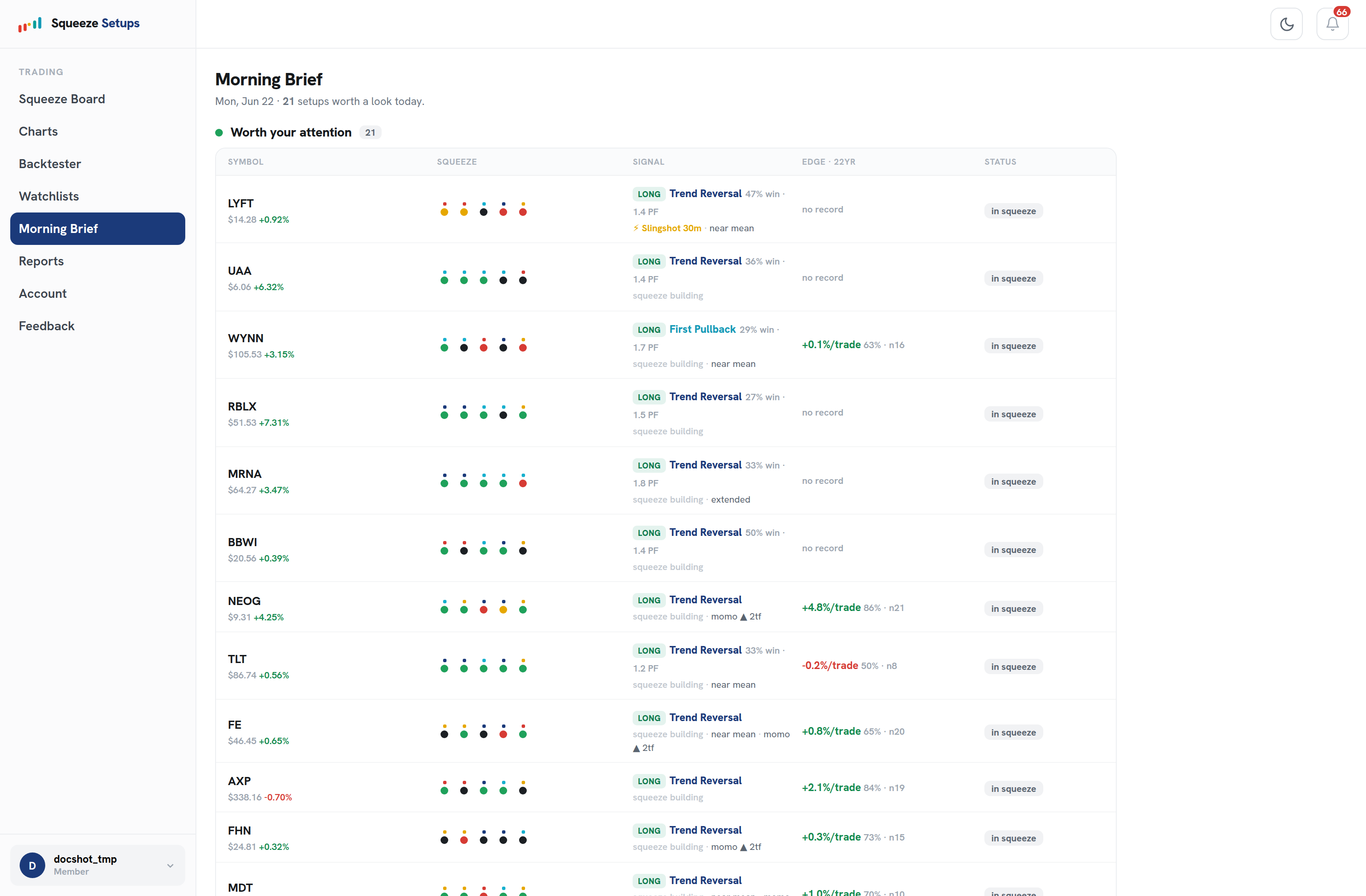
Start with the dated Morning Brief. It is a short digest of names “worth your attention” today, not the whole universe. Read the columns left to right: Symbol, Squeeze (the dots), Signal, Edge (22yr), and Status. The Signal column is labeled Trend Reversal (the Slingshot Squeeze) or First Pullback (the Squeeze Signal), each with a win percentage. The Status reads squeeze building, near mean, or extended.
You are skimming for two things: a strong Edge and a Status that is not already extended. A name that is “extended” has already run away from its mean, so the easy part of the move may be behind it. Jot down the handful that pair a high-win signal with “squeeze building.”
Step 2: Open the Board and filter
Take those names to the Squeeze Board, which shows one ranked row per stock with the full picture. The Squeeze Matrix gives you one dot per timeframe: the dot color is the tier, the number on the dot is how many bars the squeeze has lasted, and the small triangle is momentum direction. The dot tiers, per the live legend, run yellow = Tight (the tightest), red = Mid, black = Loose (the loosest), green = Fired.
Use the filter row to cut to what matters. The view tabs are All, Multi-TF Squeeze, Firing / Fired, and Positive Edge. The filter row lets you require a tier, a name with a signal, fired today, and a minimum expectancy. A practical default is Positive Edge plus a signal, so every remaining row already has a real backtest behind it. Watch the Ext column too: it tells you how far price sits above its mean in ATRs, which is the Board version of the Brief’s “extended” flag.
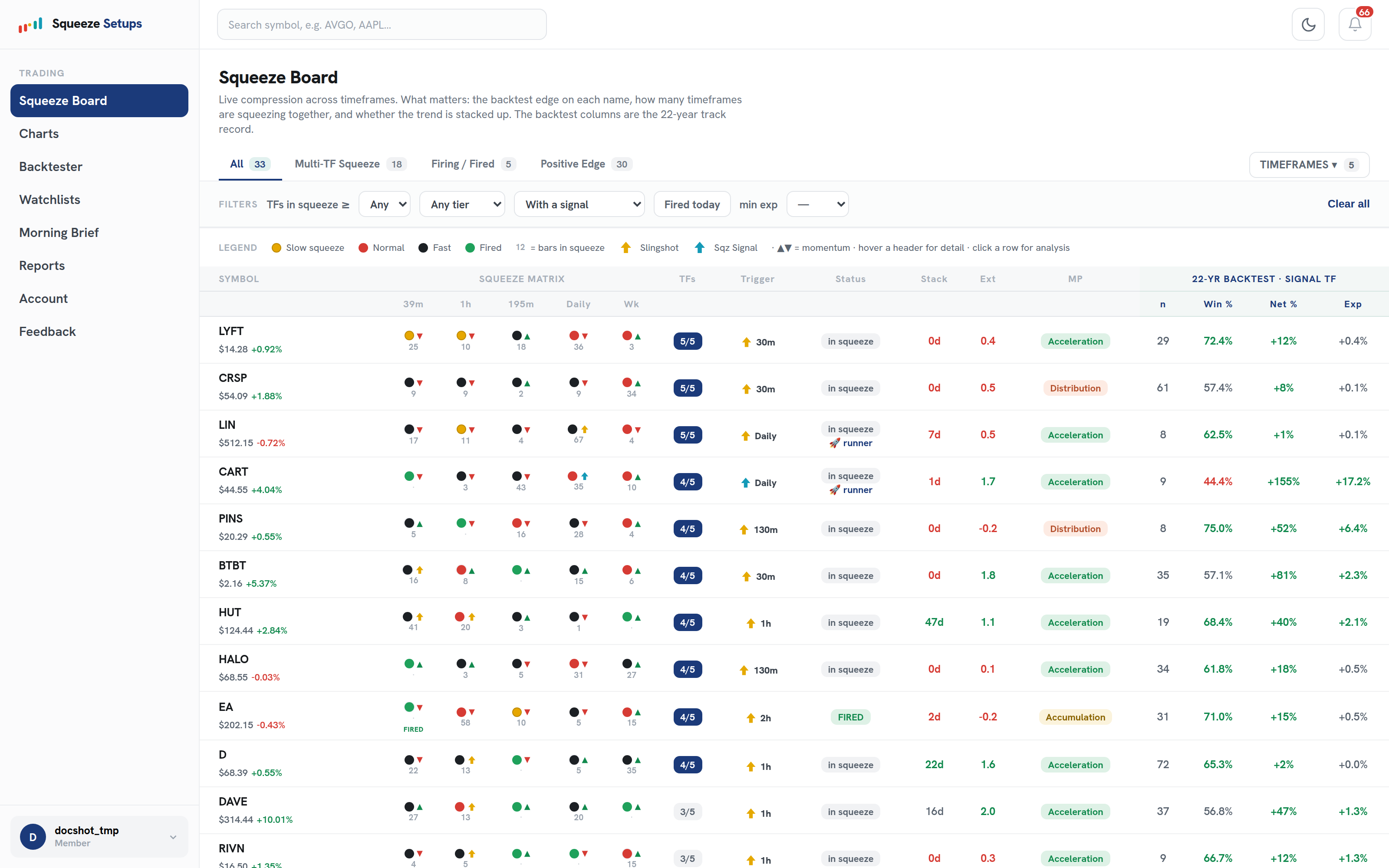
The Trigger column tells you when to act, and each arrow is tagged with its timeframe:
- A gold arrow is a Slingshot Squeeze.
- A cyan arrow is a Squeeze Signal.
- The Status column then tells you whether that trigger is still “in squeeze,” has “FIRED,” or has become a runner.
Remember the order of events for both setups: you enter on the trigger while the squeeze is still ON, and the green fire is the EXIT, not the entry.
Step 3: Qualify the name in the drawer
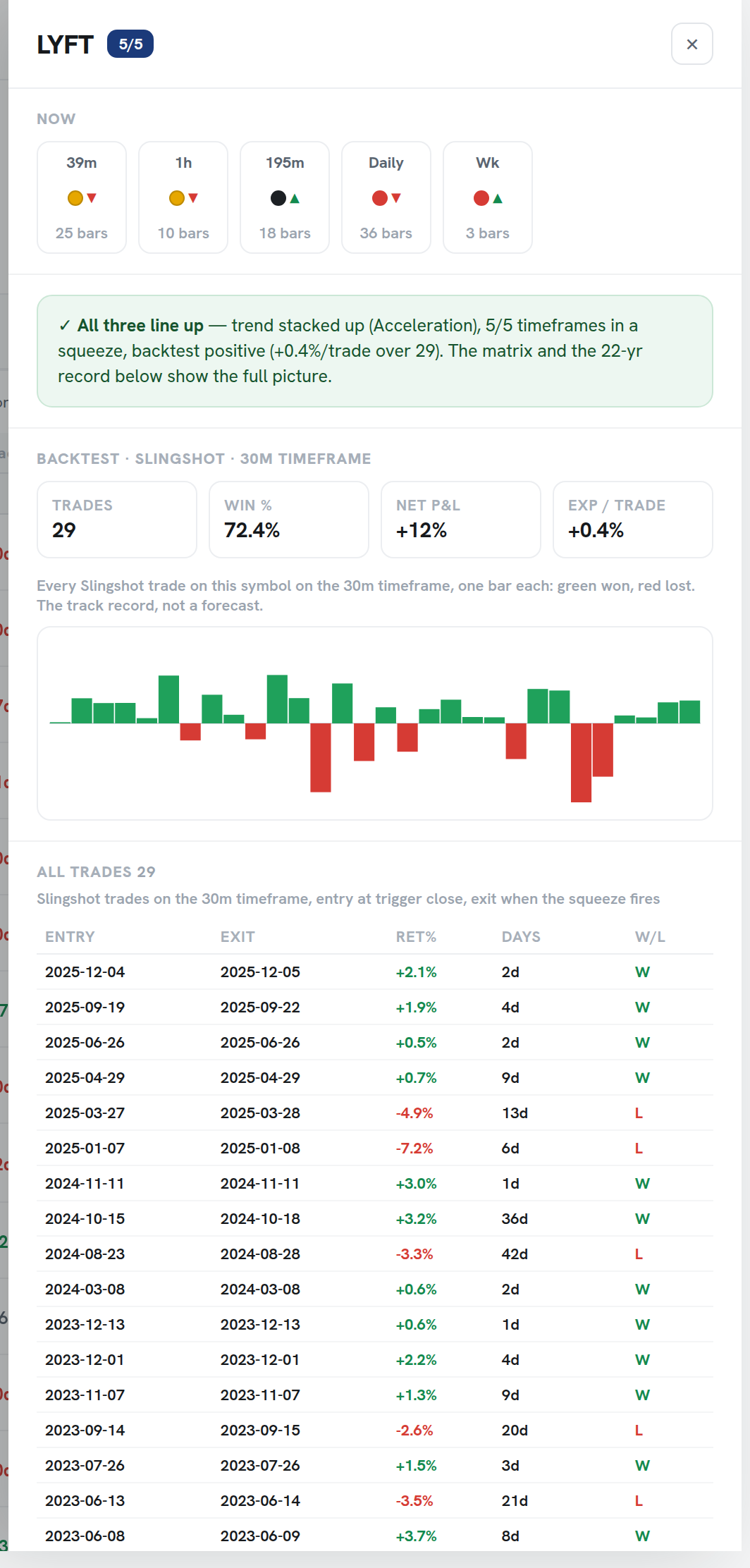
Click a row to open the Symbol drawer. This is the qualify step. The drawer gives a plain-language verdict that scores three pillars, and you want all three lining up before you commit:
- Backtest edge: the per-symbol 22-year record. It is what distinguishes a setup with a record from one without.
- Timeframe confluence: how many shown timeframes are in a squeeze at once.
- Trend: the bullish EMA stack, 8 above 21 above 34.
The drawer also shows the full 22-year record for that exact symbol: win rate, an equity strip, and every trade. This matters because the edge is per-symbol, not universe-wide. For context, our daily Slingshot Squeeze backtest across 614 stocks won 69.1% with +0.93% average per trade over 5,852 trades, and the daily Squeeze Signal won 67.4% with +0.71% per trade over 4,496 trades. But a setup is only worth taking if this name carries a positive record, which is exactly what the drawer puts in front of you.
Step 4: Confirm on Charts
From the drawer, open the symbol in Charts. This is a visual sanity check, not a second opinion that overrides the data. Toggle the EMA 8/21/34 and SMA 50/200 lines to see the stack with your own eyes, switch timeframe tabs to read the confluence, and look at the squeeze row under price for each timeframe. The trigger arrow is marked under the trigger candle on the trigger’s timeframe, so you can see precisely where the setup printed. If the chart contradicts the drawer (a broken stack, a squeeze that already fired), pass and move on.
Step 5: Enter on the trigger while the squeeze is on
Entry timing is where mistakes happen, so be precise. Enter on the trigger while the squeeze is still ON. The Slingshot Squeeze enters when momentum turns up from below zero while the squeeze is on, in a stacked uptrend, with Edge Signal confirmation. The Squeeze Signal is a continuation: momentum is already above zero and the compression tightens a tier. Do not wait for the green dot. The green fire is the exit.
One reason we do not chase the fire: roughly 46% of long signals never pull back even 1 ATR, and those runners won about 92%. Waiting for a clean pullback that never comes means missing those trades. Sizing and stops are yours to set, but the average adverse excursion in our data was about 1.6 ATR, which is a useful frame of reference for where a stop sits.
Step 6: Manage and exit on the fire
Once you are in, the Board manages the position for you. The Status column flips to “FIRED” or shows a runner chip, the Stack column tells you how many days the bullish EMA stack has held, and Ext tells you how stretched price has become. Hold while the squeeze is on, and treat the green fire as your exit cue. For reference, daily Slingshot Squeeze trades held about 13 days and Squeeze Signal trades about 15 days, so this is a swing routine rather than a day trade. At the end of the session, the Reports page recaps signals fired today, live triggers with edge, open runners, and average expectancy, which closes the loop into tomorrow’s scan.
The six steps and their screens
| Step | Screen | What you decide |
|---|---|---|
| 1. Scan | Morning Brief | Which few names are worth opening |
| 2. Board | Squeeze Board + filters | Which have a live trigger and positive edge |
| 3. Qualify | Symbol drawer | Whether all three pillars line up for this name |
| 4. Confirm | Charts | Whether the chart agrees with the data |
| 5. Enter | Board trigger | Act on the trigger while the squeeze is on |
| 6. Manage | Board Status + Reports | Hold until the fire, then log it |
A note on honesty before you run this for real: even the strongest daily setup lost roughly one trade in three. These figures are historical backtests, before commissions and slippage, and the intraday Squeeze Signal backtest is still in progress, so trust the daily timeframe most. The routine does not promise winners. It just makes sure every trade you take has all three pillars behind it.
Squeeze Setups is an educational research tool, not financial advice.
Related: The Morning Brief, How to Read the Squeeze Board, The Symbol Drawer