Market Pulse and the Four Stages
Key takeaways:
- Market Pulse (the MP column) is a trend gate: it labels each stock as Acceleration, Accumulation, Distribution, or Deceleration.
- Acceleration and Accumulation are the constructive stages for long setups; Distribution and Deceleration are warnings.
- A squeeze in a constructive stage lines up with the trend pillar (EMA 8>21>34); a squeeze in a destructive stage is fighting it.
- MP is a filter, not a trigger. It tells you whether a Slingshot Squeeze or Squeeze Signal is worth taking, not when to enter.
Market Pulse answers one question before you ever look at a trigger: is this stock in a stage where a long squeeze setup has the trend in its favor? On the Squeeze Board it is the MP column, and it reads one of four words: Acceleration, Accumulation, Distribution, or Deceleration. We use it as the trend gate. The dots tell you a squeeze is compressing; Market Pulse tells you whether that compression is happening inside a constructive stage or a deteriorating one.
What does the MP column measure?
Market Pulse classifies where a stock sits in its trend cycle by combining trend direction with momentum behavior. It is a four-stage loop a stock rotates through over time. Two of those stages are friendly to the long setups we run by default, and two are not. It is the same idea as our trend pillar (the EMA 8>21>34 stack), but expressed as a stage label instead of a yes/no, so you can tell the difference between a stock that is just turning up and one that is already extended and rolling over.
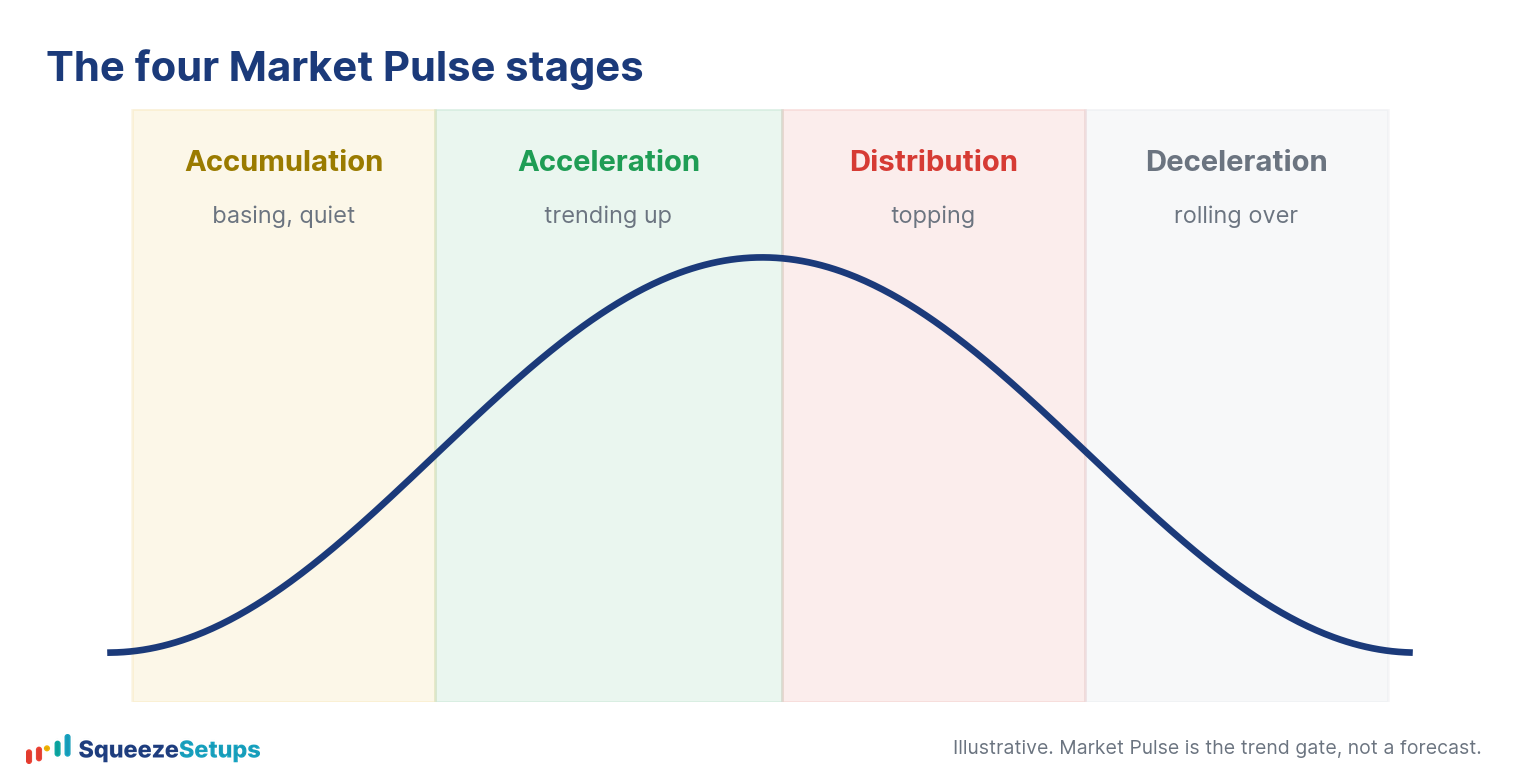
The four stages
Acceleration. Price is trending up and momentum is expanding in the same direction. This is the strongest constructive stage. A squeeze that compresses here is loading energy into an already healthy uptrend, which is exactly the context a Slingshot Squeeze or Squeeze Signal is built for.
Accumulation. The trend is building but quieter: price is basing or rising gently while strength gathers under the surface. This is the early constructive stage. Many of the best entries sit here, because the squeeze can fire before the move is obvious. A bullish setup in Accumulation is taking the trade before the crowd, not after.
Distribution. Price is still high but momentum is fading and supply is coming in. This is a warning. A long squeeze that fires in Distribution is firing into weakening demand, so even a clean trigger is suspect. We treat Distribution as a reason to demand more from the other pillars, or to skip.
Deceleration. The trend has turned down and momentum is contracting against any long thesis. This is the destructive stage. A long setup here is fighting the tape outright. Unless the symbol carries a positive per-symbol short record, this is not a stage we trade long.
| Stage | Trend posture | For long setups |
|---|---|---|
| Acceleration | Uptrend, momentum expanding | Best context |
| Accumulation | Building, strength gathering early | Constructive, often early |
| Distribution | High but momentum fading | Warning, demand more confluence |
| Deceleration | Downtrend, momentum contracting | Avoid long |
How Market Pulse filters which squeezes are worth taking
A squeeze on its own is not an edge. Our backtest is blunt about this. None of the obvious entry tweaks beat a random day:
- Bare squeeze: won about 53.9%, no better than a random day at 53.7%.
- Waiting for five dots: 54.1%.
- First green dot: 54.8%.
- Pullback to the 34 EMA: 45.5%.
- Pullback to the 50 SMA: 44.4%.
The edge shows up only when the squeeze sits inside the right context.
That context is what Market Pulse helps enforce. The validated daily setups are strong because they trade compression inside a healthy trend, not compression in isolation:
- Daily Slingshot Squeeze: won 69.1% across 5,852 trades at +0.93% average per trade, holding 66.8% to 70.9% across five separate eras.
- Daily Squeeze Signal: won 67.4% across 4,496 trades at +0.71% per trade, era-stable from 64.9% to 71.3%.
Those numbers come from setups taken in constructive conditions. A squeeze firing in Deceleration is the opposite of that, and one trade in three still lost even in the good cases.
So the practical rule is simple. When you scan the board and a row shows a gold arrow (Slingshot Squeeze) or a cyan arrow (Squeeze Signal), glance at MP first. Acceleration or Accumulation means the trend pillar agrees with the trigger. Distribution or Deceleration means it does not, and you should let the other two pillars, the per-symbol 22-year backtest edge and timeframe confluence, carry far more weight before you act, if you act at all.
Where to read it on the platform
Market Pulse appears as the MP column on the Squeeze Board, one value per ranked row, sitting alongside Status, Stack (days the bullish EMA stack has held), and Ext (how far price is above its mean, in ATRs). Read MP together with Stack and Ext: Acceleration with a long-held stack and modest extension is a cleaner picture than Acceleration that is already several ATRs extended. When you open a symbol drawer, the same idea shows up inside the plain-language verdict, where the trend pillar is one of the three scores the board uses to rank every row.
None of this replaces the trigger. Market Pulse does not tell you when to enter; the setup does that, and you enter on the trigger while the squeeze is still on, with the green fire as your exit. MP just tells you whether the setup in front of you is happening in a stage where the odds have historically been on your side.
Please note: This research is based on historical backtest data. It is NOT a prediction, and it is NOT financial advice.
Related: How to read the Squeeze Board, What is the squeeze?, Multi-timeframe squeeze confluence