The Slingshot Squeeze, Explained
Key takeaways
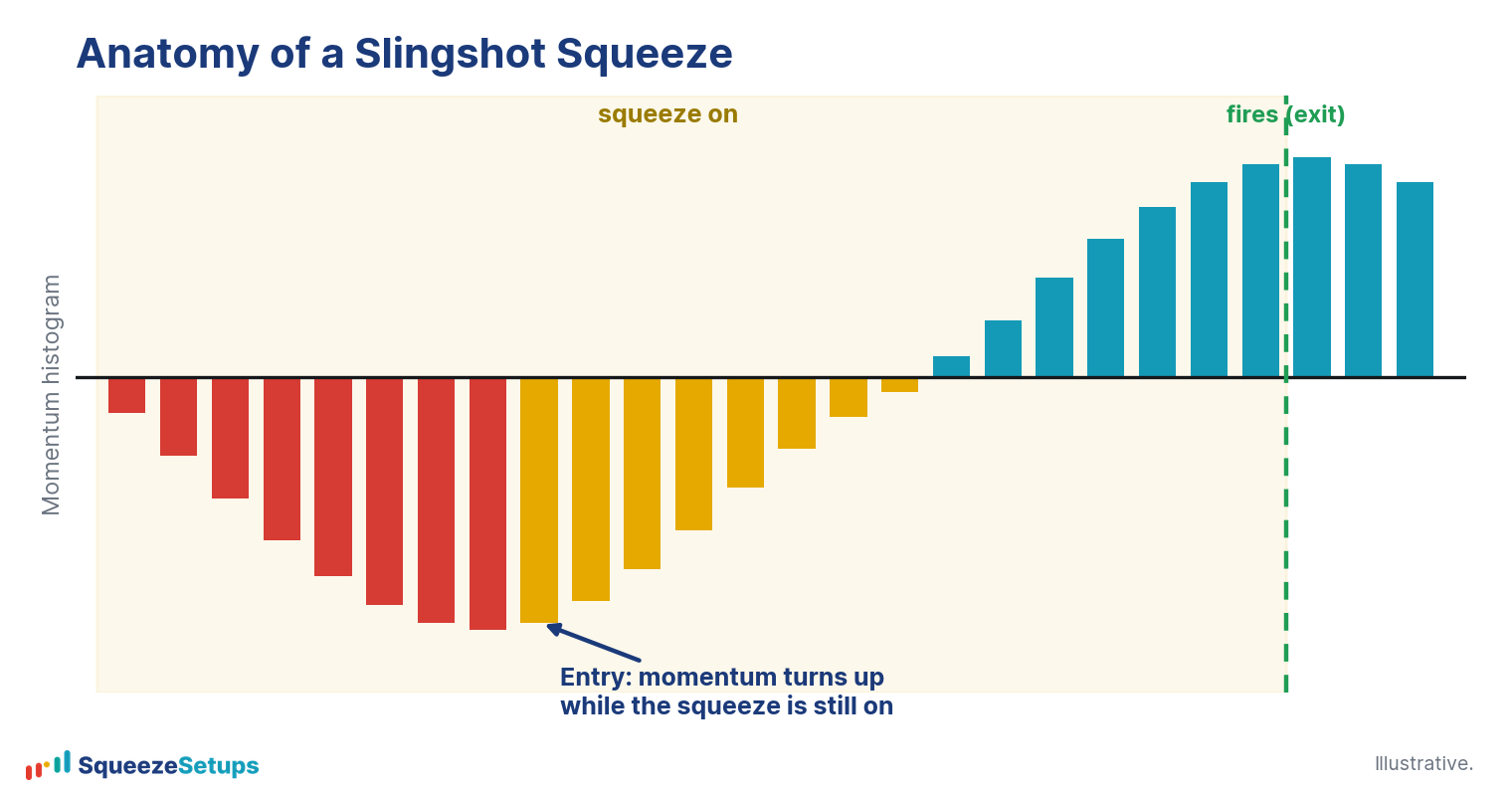
- The Slingshot Squeeze is a momentum-turn entry: you get in when momentum turns up from below zero while the squeeze is still on, in a stacked uptrend.
- On the daily timeframe it won 69.1% across 5,852 trades over 22 years, average hold about 13 days.
- The win rate held between 66.8% and 70.9% in every five-year era from 2004 to 2026.
- You enter on the trigger while the squeeze is on, and you exit when the squeeze fires. The green dot is the exit, not the entry.
The Slingshot Squeeze is our name for a specific squeeze setup. You enter when momentum turns up from below zero while the squeeze is still on, in a stacked uptrend, with Edge Signal confirmation. On the daily timeframe it won 69.1% of the time across 5,852 trades over 22 years in our backtest.
What is the Slingshot Squeeze?
Consider a stock that has been selling off. Momentum is below zero, the squeeze is still on, and then momentum stops falling and starts curling back up. We want to be in before it releases, not after. The bar where momentum is still below zero but rising is the turn. That is the moment the setup triggers.
What has to line up?
A Slingshot is not just any squeeze. Five things have to be true on the same bar:
- A squeeze is on. The dots are colored, so energy is still stored.
- Momentum is below zero and turning up. The down-move is losing force and reversing.
- The trend is stacked up. The moving averages line up in order, 8 over 21 over 34 over 50 over 200.
- Price has reclaimed the middle of its trend. The close is at or above the 34 EMA.
- The Edge Signal confirms. This is our read that real momentum is behind the move, built into the arrow. It is the difference between a real turn and a random tick.
The trend filter is what does most of the work. Without it, a momentum turn fires constantly, and most of those are counter-trend bounces inside downtrends. Requiring the stack throws those away and keeps the turns that point the same way as the larger trend.
When do you enter and exit?
You enter on the trigger, while the squeeze is still on. That is your starter. If price pulls back afterward, you add to bring the position to full size at a better price. You exit when the squeeze fires, the green dot.
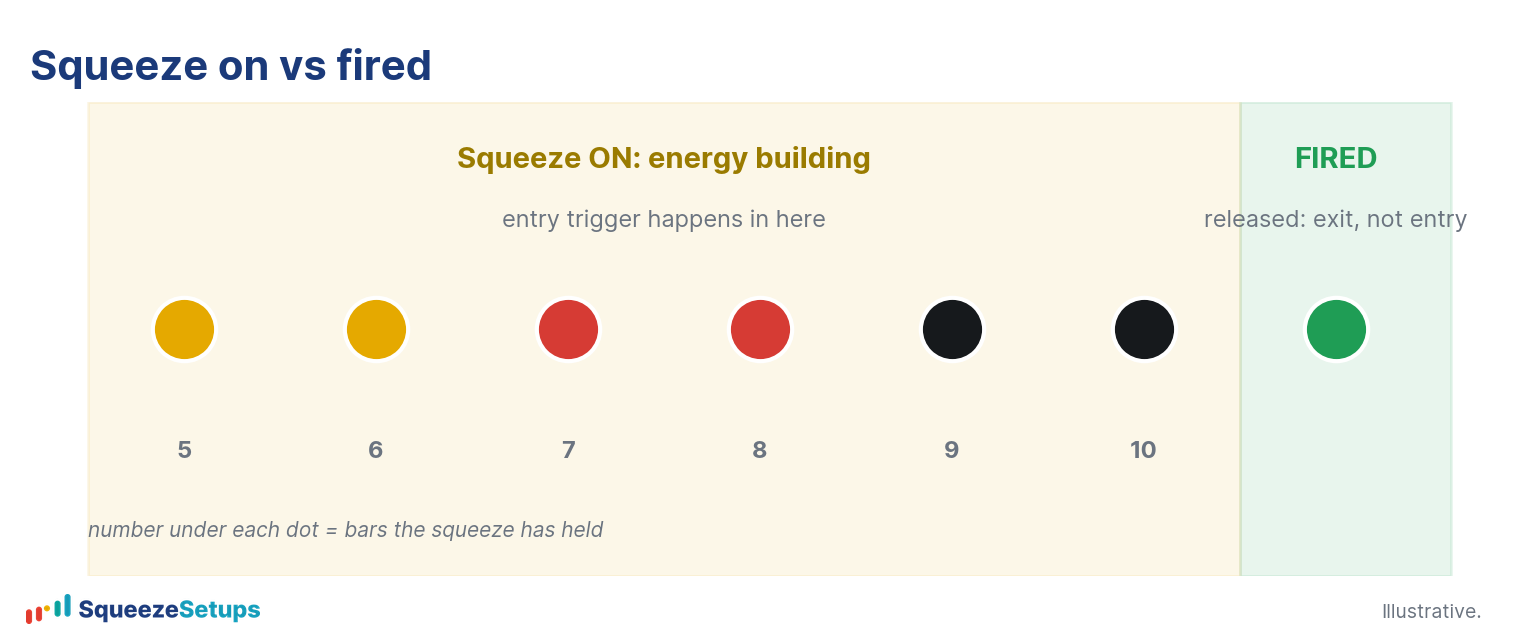
This is earlier than buying the first green dot, and on purpose: by the time a squeeze fires, a good part of the move is often already gone.
What is its track record?
On the daily timeframe, the Slingshot Squeeze produced this record in our 22-year backtest:
| Metric | Daily, 2004 to 2026 |
|---|---|
| Win rate | 69.1% |
| Trades | 5,852 |
| Average hold | About 13 days |
| Average per trade | +0.93% |
| Cumulative, fixed position | About +5,460% |
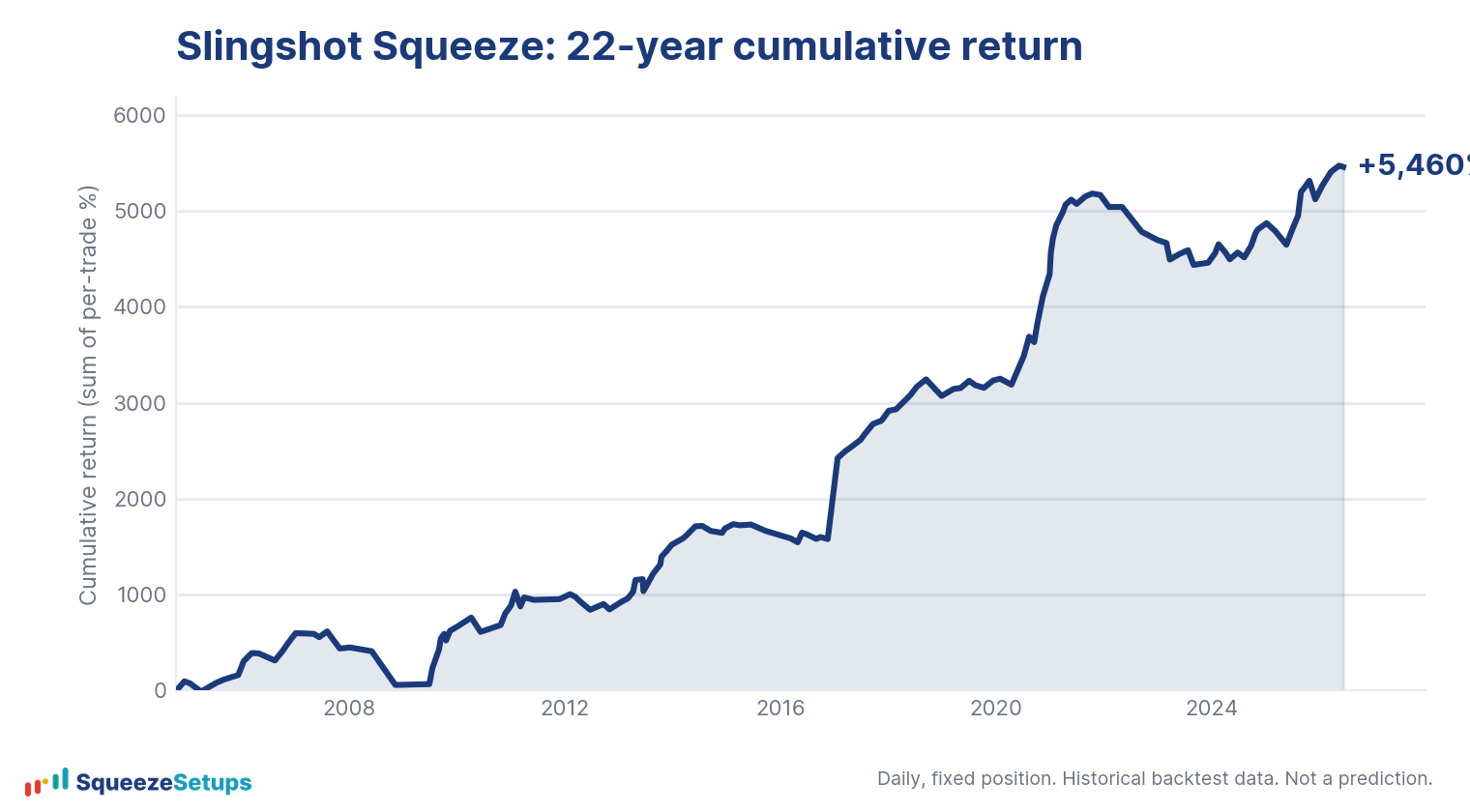
The more important point is that the edge held. The daily win rate stayed between 66.8% and 70.9% in every five-year era we tested, through the 2008 crash, the 2020 crash, and the bull runs between. That stability is why we treat it as a real edge rather than a curve fit.
What it does not promise
A few things this edge does not promise:
- Roughly one trade in three still lost in our sample.
- The figures are from historical backtests, not a forecast, and are measured before commissions and slippage.
- The setup is long-biased.
- A win rate is an edge across many trades, not a guarantee on the next one.
Please note: This research is based on historical backtest data. It is NOT a prediction, and it is NOT financial advice.
Related: The Squeeze Signal, explained · Why a bare squeeze has no edge · What is the Squeeze?
Practice it: the Squeeze stock market game
Read real squeeze charts with the symbol hidden, call long, short or pass, and see what happened. Free, ten new charts every day. Play the Squeeze stock market game