The Short Side: Why We Are Long-Biased
Key takeaways
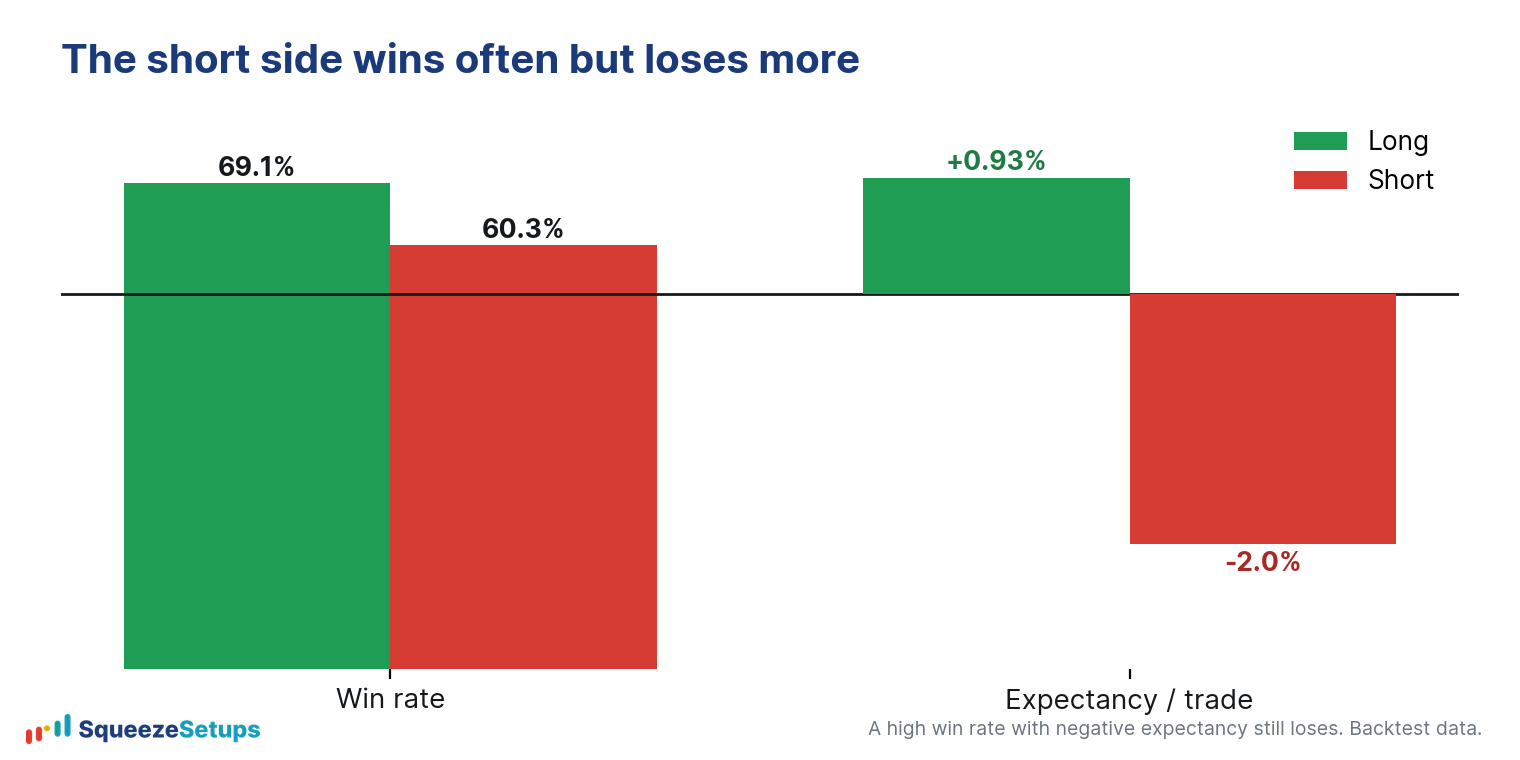
- The short Slingshot Squeeze won 60.3% of the time, yet its expectancy was about -2.0% per trade. It loses money despite winning more often than it loses.
- Win rate alone tells you nothing about whether a strategy makes money. Expectancy, the average result per trade, is what decides it.
- Shorting only paid off on the specific names that carried a positive per-symbol short record, so we default long and treat the short side as the exception.
We are long-biased by default, and the reason is not a hunch about market direction. It is a number. When we ran the Slingshot Squeeze short, the version that bets on price falling, it won 60.3% of its trades and still lost money.
The average trade came out to roughly -2.0%. That gap between a healthy win rate and a losing result is why the board points you long unless a symbol has a positive short record on its own history.
How can a 60% win rate lose money?
A win rate is just the share of trades that closed green. It says nothing about how big the wins were compared to the losses.
The short Slingshot won often, but when it lost, it lost more than a typical win returned. Stack enough oversized losers against a pile of small winners and the math turns negative no matter how many green trades you count.
The single number that settles this is expectancy: the average profit or loss across every trade, winners and losers together. A strategy with positive expectancy makes money over enough trades.
A strategy with negative expectancy bleeds money over enough trades. The short Slingshot had a good win rate and negative expectancy, which is a problem, because the win rate looks fine right up until the account shrinks.
Long versus short, side by side
Put the two directions next to each other and the contrast is plain. The daily long Slingshot is positive on both measures. The short is positive on win rate alone, and that one number does not save it.
| Direction | Win rate | Expectancy / trade | Verdict |
|---|---|---|---|
| Slingshot Squeeze, long (daily) | 69.1% | +0.93% | Profitable across 22 years |
| Slingshot Squeeze, short (daily) | 60.3% | about -2.0% | Loses money despite winning often |
The long side did not just edge ahead. It cleared every era we sliced it into, holding a 66.8% to 70.9% win rate from 2004 through 2026, with positive expectancy throughout. The short side never found that footing across the broad universe.
Why the short side struggles
Stocks in our 614-name universe spent 22 years inside a long-term upward drift. A short bet is fighting that drift.
Even a clean squeeze setup that resolves downward runs into the tendency of these names to recover, so the losers stretch out while the winners get cut short. That asymmetry is exactly what drags expectancy below zero even when the count of winners looks fine.
This is the mirror image of what makes the long side work. On the long side, the same upward drift works in your favor, the trend stack tends to persist, and a meaningful share of signals never pull back before running. On the short side, all of that works against you.
When does shorting actually pay?
The short side is not banned. It is conditional. Some individual symbols carry a positive per-symbol short record, names whose own 22-year history shows the short Slingshot made money on that specific stock.
Those are the only places we would consider it, and the per-symbol backtest is how you find them. The universe-wide number is negative, but the distribution underneath it is not uniform, and a handful of names buck the trend.
This is why the methodology leans on the per-symbol edge as its first pillar rather than a single blanket rule. The board and the Backtester both show you the record for the exact symbol and direction you are looking at, so you are never relying on the average when the specific case is what matters.
If a name does not have a positive short record of its own, the default holds: trade it long or skip it.
The honest caveat
None of this means the long side is free money. Even at 69.1%, roughly one trade in three still lost. And every figure here is a historical backtest, measured before commissions and slippage.
The point is narrower and more durable: judge a strategy by its expectancy, not its win rate, and let each symbol’s own record decide which direction you take. For the broad universe, that math says long.
Please note: This research is based on historical backtest data. It is NOT a prediction, and it is NOT financial advice.
Related: Does the squeeze actually work?, Backtesting the squeeze: 22 years, per symbol, How to trade the squeeze