Why a Bare Squeeze Has No Edge: A 22-Year Study
Key takeaways
- Over 22 years, buying a stock just because it was in a squeeze won about 54% of the time. Buying on a random day won 53.7%. The squeeze alone added nothing.
- The popular shortcuts did not help. Waiting for five dots won 54%. Buying the first green dot won 55%. Buying the pullback to the 34 EMA or 50 SMA was worse, around 45%.
- Filtering the same squeezes for a momentum turn, a stacked trend, and Edge Signal confirmation raised the win rate to about 67 to 68% in our backtest.
- The squeeze is necessary, not sufficient. The edge is in which squeezes you take.
A bare squeeze has no edge. In our 22-year backtest across 614 stocks, buying simply because a squeeze was on won about 54% of the time, the same as buying on a random day and holding for the same length of time. The squeeze tells you energy is stored.
It does not tell you direction. In our sample, the edge only appeared once we filtered for a momentum turn, a stacked trend, and confirmation.
What is a bare squeeze?
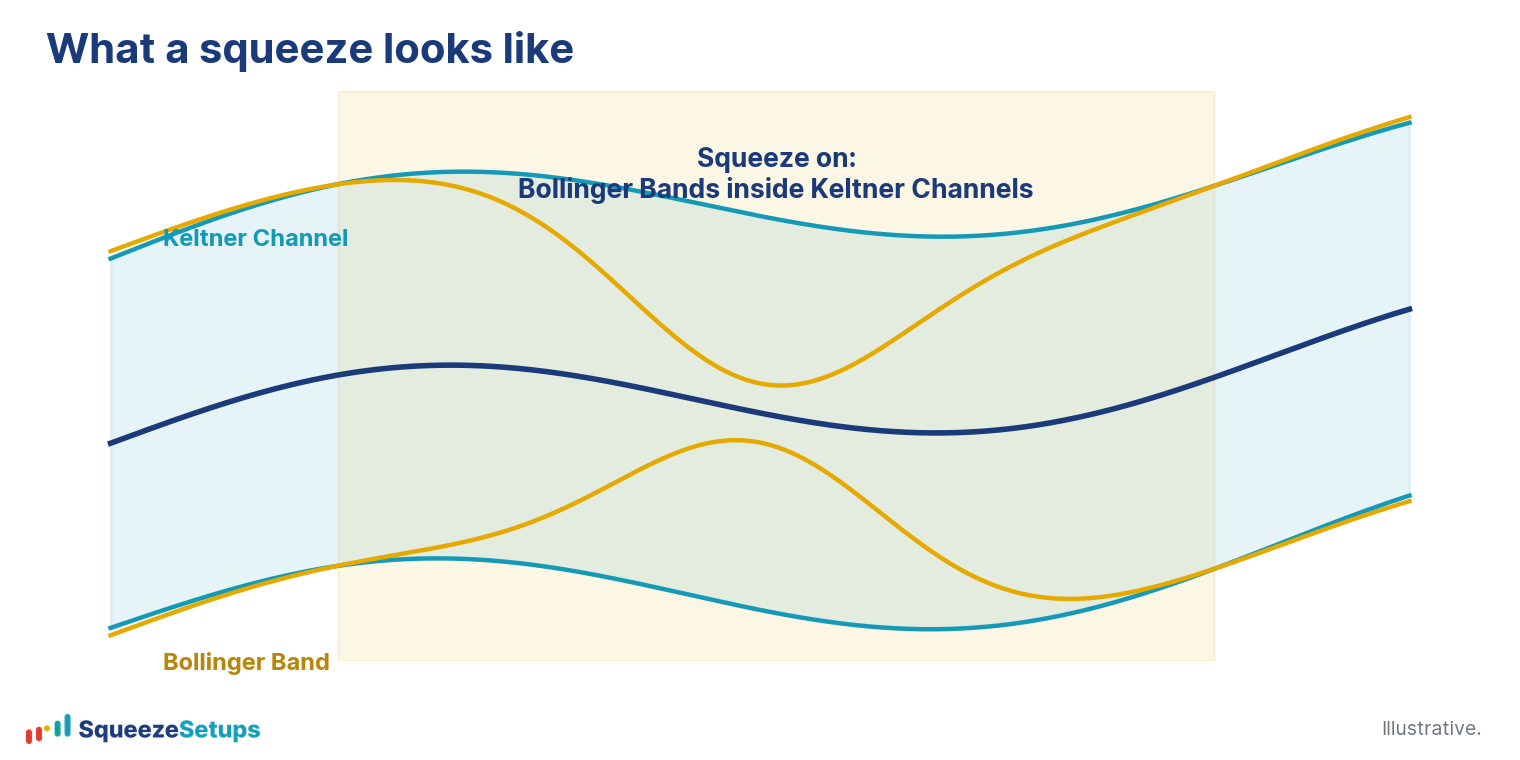
A squeeze is a volatility signal. When the Bollinger Bands contract inside the Keltner Channels, price has compressed into an unusually tight range.
A bare squeeze means acting on that compression alone, buying because the dot appeared, with no other condition attached. It is the most common way the squeeze gets traded, and in our testing it was also the least profitable.
Does buying the squeeze actually work?
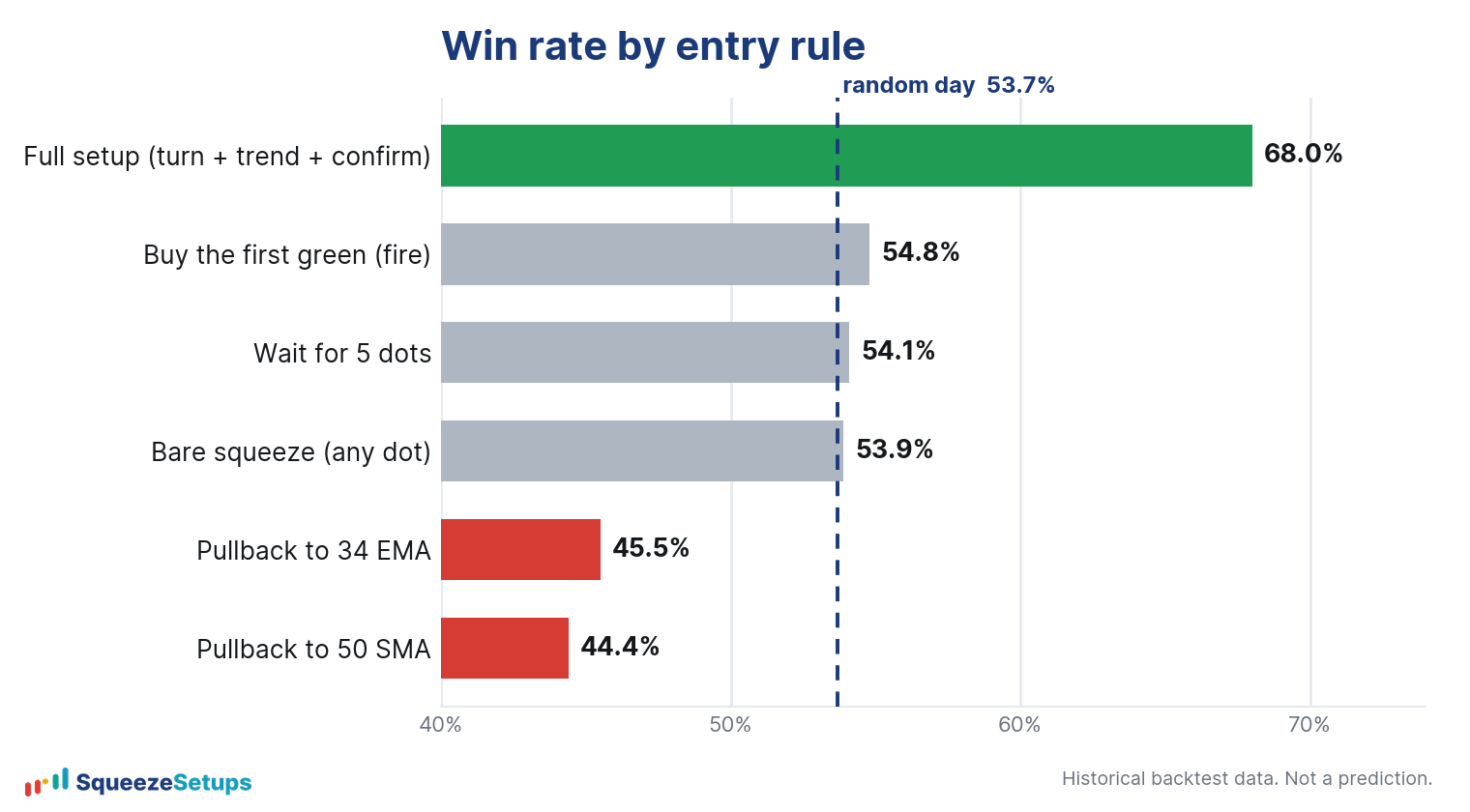
No. We held the exit constant, exiting when the squeeze fires, and changed only the entry rule. Entering on a bare squeeze produced a 53.9% win rate over 22 years.
Buying on a random day and holding the same number of days produced 53.7%. The squeeze on its own moved the win rate by two tenths of a point, which is noise. After commissions and slippage, a coin flip is a slow loss.
Do the popular shortcuts help?
We tested the three most common ones. None produced an edge, and two made it worse.
| Entry method | Win rate | vs. random day (53.7%) |
|---|---|---|
| Bare squeeze (buy any dot) | 53.9% | about even |
| Wait for 5 dots, then buy | 54.1% | about even |
| Buy the first green dot (the fire) | 54.8% | about even |
| Squeeze plus pullback to the 34 EMA | 45.5% | 8 points worse |
| Squeeze plus pullback to the 50 SMA | 44.4% | 9 points worse |
| Full setup (turn, trend, confirmation) | about 68% | 14 points better |
Why is buying the pullback worse?
Because in a live squeeze, a pullback to the 34 EMA or the 50 SMA is often the start of a failure rather than a discount. Buying that dip won only 44 to 45% of the time in our sample, below a random entry. You are buying weakness while the range is still compressing.
What actually creates the edge?
Three filters, applied on top of the squeeze.
- The momentum turn. Momentum has to be curling in your direction, not just any squeeze.
- The trend. The moving averages have to be stacked, so you are trading compression in the direction the market already leans.
- Edge Signal confirmation. This is our read that real momentum is behind the move, and it is built into every Slingshot Squeeze and Squeeze Signal arrow.
Apply all three to the same set of squeezes and the win rate rose to about 67 to 68% in our backtest, roughly two in three. The dots were the same and the stocks were the same. The only thing that changed was which squeezes we were willing to act on.
How we tested this
The setup was the same for every entry method, so the only variable is the entry rule.
- 22 years of daily data, from 2004 to 2026, across 614 stocks.
- Exit held constant: we exit when the squeeze fires.
- Long only, one entry per qualifying bar, before commissions.
We report win rate rather than average return because a few outlier moves can flatter a low-hit-rate method, and the hit rate is more stable across samples.
Please note: This research is based on historical backtest data. It is NOT a prediction, and it is NOT financial advice.
Related: What is the Squeeze? · The Slingshot Squeeze, explained · See what is in a squeeze today.