How a Squeeze Fires, and How to Tell Which Way
Key takeaways
- A squeeze fires when volatility expands: the Bollinger Bands push back outside the Keltner Channels after a period of compression.
- The fire tells you when, not which way. The squeeze itself carries no direction.
- Direction comes from two other things: the sign of momentum (above or below zero) and the trend stack (EMA 8 above 21 above 34).
- In our 22-year backtest of 614 stocks, a bare squeeze fire won ~53.9%, no better than a random day at 53.7%. The edge lives in reading direction, not in the fire.
A squeeze is a period of low volatility. It fires when that volatility expands. The exact mechanic: price compresses until the Bollinger Bands sit inside the Keltner Channels, and the fire is the moment the Bands widen back outside the Channels again. That release tells you the quiet period is over. It does not tell you whether price is about to go up or down. To read the likely direction you have to look elsewhere: at momentum and at the trend stack. This article walks through the mechanics of the fire, then how we read direction off the chart.
What actually happens when a squeeze fires
Volatility moves in cycles. Price contracts into a tight range, then it expands. The squeeze is the contraction phase. Mechanically, the Bollinger Bands measure recent volatility and the Keltner Channels measure a smoothed average range. When volatility drops, the Bands shrink inside the Channels, and that nested state is the squeeze being “on.” When volatility expands again, the Bands push back outside the Channels, and that is the fire.
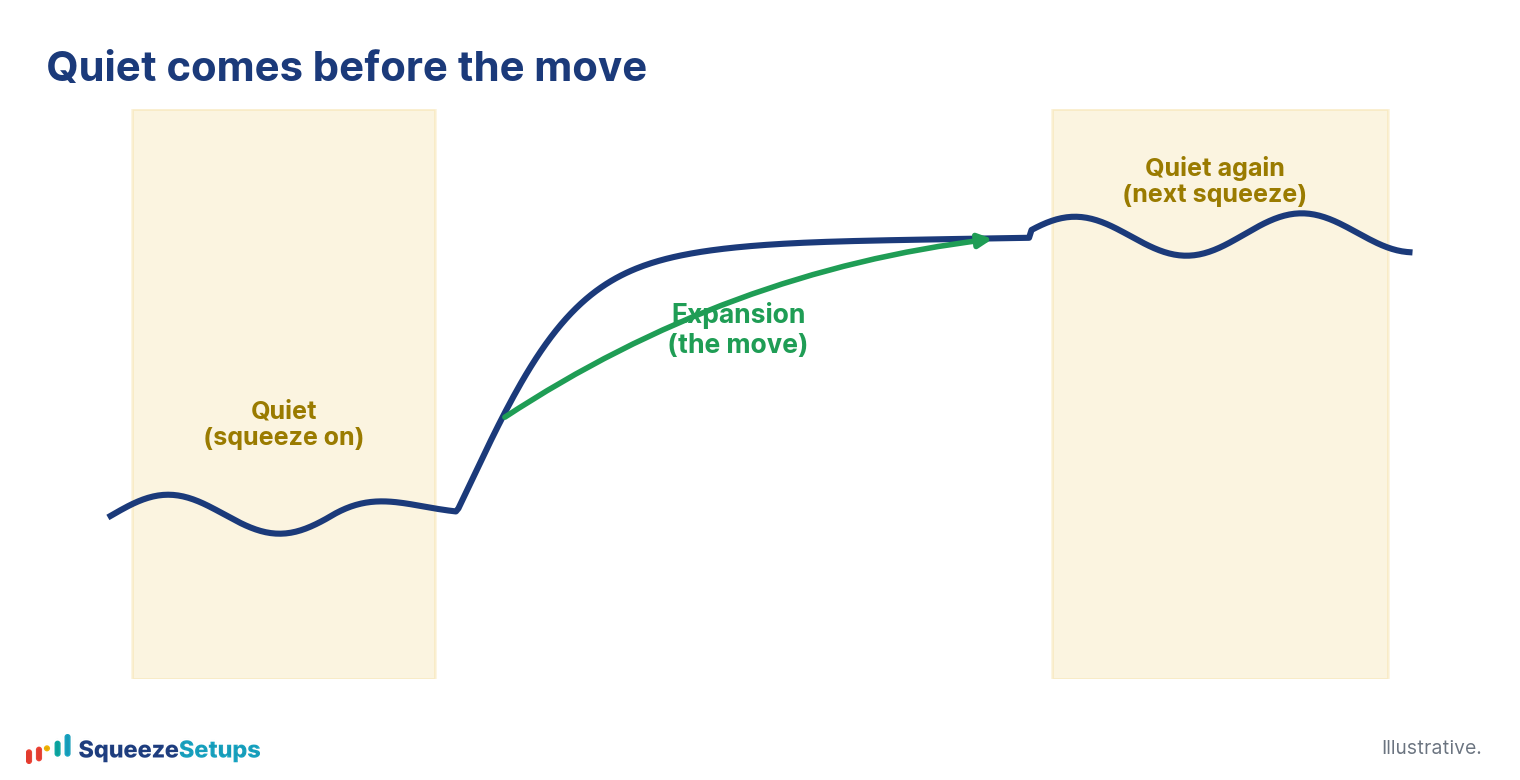
On the Squeeze Board this state shows up as a dot per timeframe. The dot color is the tier of compression, and the small number on the dot is how many bars the squeeze has lasted. When a squeeze releases, the dot turns green for “Fired.” That is the volatility expansion happening, nothing more.
The fire tells you when, not which way
People often misread this. A green “Fired” dot means the quiet is over, but it is silent on direction. Volatility can expand up or down. We tested the naive version of this directly: enter long on a bare squeeze fire across all 614 names over 22 years. The result was ~53.9% wins, which is statistically indistinguishable from buying on a random day (~53.7%).
Variations did not rescue it either:
- Wait for five dots: around 54.1%.
- Buy the first green dot: around 54.8%.
- Pullback to the 34 EMA: ~45.5%, worse than random.
- Pullback to the 50 SMA: ~44.4%, also worse than random.
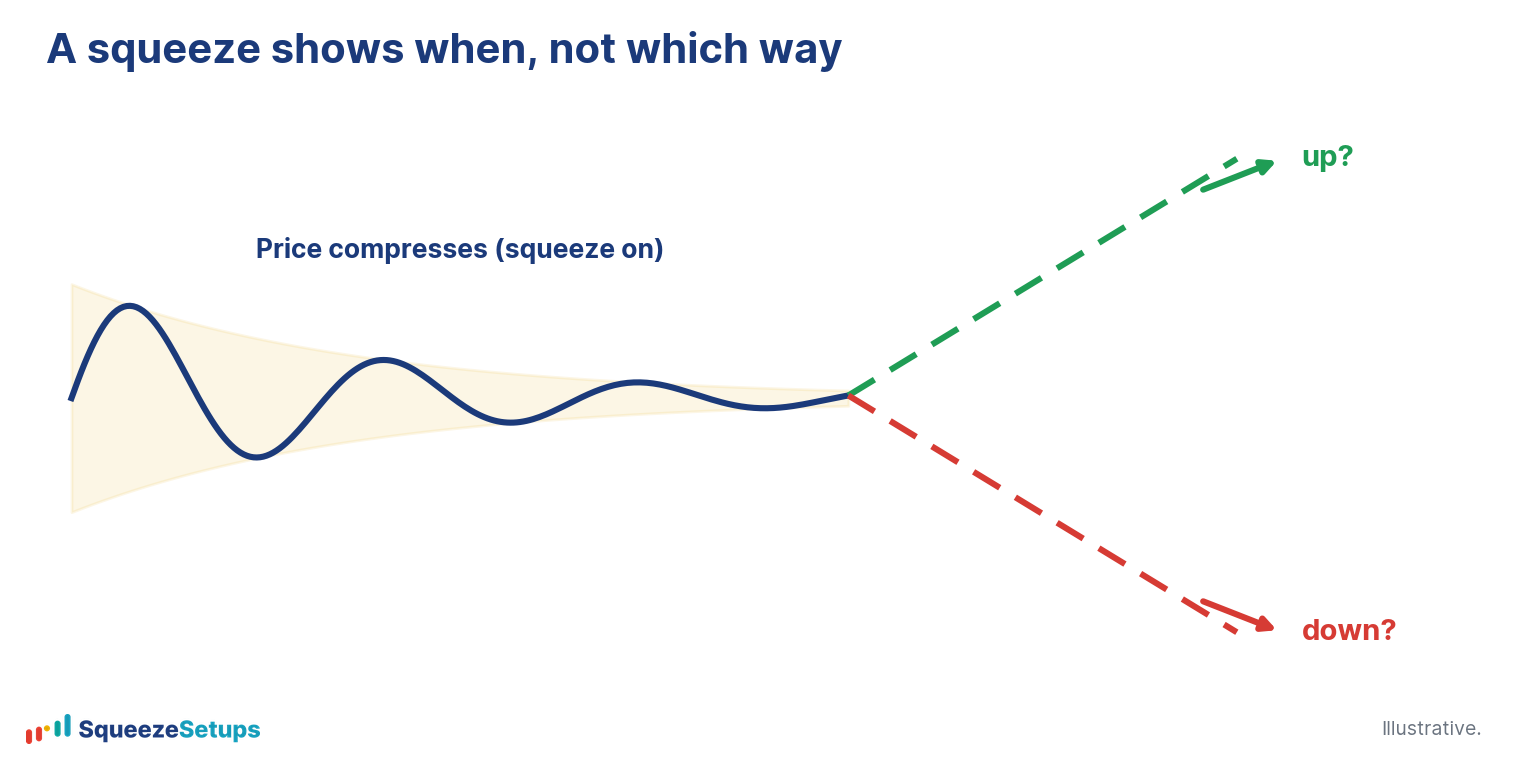
So the fire is a timing event, not a buy signal. If you treated every fire as a long entry you would be flipping a slightly weighted coin. The information you need is added on top of the fire.
Reading direction: momentum sign
The first directional input is momentum: is it above or below the zero line, and is it turning. Momentum above zero means buyers are in control of the recent range; below zero means sellers are. The turn matters as much as the sign. Momentum rising up toward and through zero from below is a different setup than momentum already above zero and accelerating.
This is exactly the distinction between our two validated setups. A Slingshot Squeeze is a reversal: momentum turns up from below zero while the squeeze is still on, in a stacked uptrend, with Edge Signal confirmation. A Squeeze Signal is a continuation: momentum is already above zero and the compression tightens another tier. In both cases you enter on the trigger while the squeeze is still ON. The green fire is the EXIT, not the entry.
Reading direction: the trend stack
The second input is the trend stack, the order of the moving averages. When the EMA 8 is above the EMA 21 and the EMA 21 is above the EMA 34, the trend is stacked bullish. That stack is the context that biases a fire upward. A squeeze that fires inside a clean bullish stack is far more likely to resolve up than one firing into a tangle of crossing averages.
On the board this is the Stack column: how many days the bullish EMA stack has held. Combined with momentum sign, the stack turns a directionless fire into a directional read. Neither input lives in the squeeze; both are layered on top of it.
Why the layered read pays
When we combine momentum turning up, a stacked uptrend, a still-on squeeze, and a positive per-symbol backtest, the numbers move a long way from the coin flip. Here is how the bare fire compares to the two validated daily setups across our 22-year, 614-stock universe.
| Entry | Win % | Avg / trade | Trades |
|---|---|---|---|
| Random day | ~53.7% | n/a | baseline |
| Bare squeeze fire (long) | ~53.9% | n/a | baseline |
| Slingshot Squeeze (daily) | 69.1% | +0.93% | 5,852 |
| Squeeze Signal (daily) | 67.4% | +0.71% | 4,496 |
The lift from ~54% to ~67 to 69% is the entire value of reading direction rather than reacting to the fire. The Slingshot win rate held in a tight band (66.8% to 70.9%) across five separate eras, and the Squeeze Signal held from 64.9% to 71.3%, so this is not one lucky stretch. Note the daily Squeeze Signal is the validated one; the intraday version is still in progress. And honesty requires the caveat: roughly one trade in three still lost, and these are historical backtests before commissions and slippage, never a forecast.
How to read it on the platform
You do not have to eyeball the Bands and Channels yourself. The Squeeze Board surfaces each piece of the read for every name:
- SQUEEZE MATRIX dots: the compression state per timeframe, turning green on the fire.
- Trigger column: a gold arrow for a Slingshot Squeeze or a cyan arrow for a Squeeze Signal, with the timeframe, which is the directional read already applied.
- Stack column: the trend context.
- 22-Yr Backtest columns: the per-symbol record.
Open a row’s drawer to see the plain-language verdict scoring the three pillars: trend stacked, timeframe confluence, and a positive backtest. That is the same logic this article describes, computed for every name.
Please note: This research is based on historical backtest data. It is NOT a prediction, and it is NOT financial advice.
Related: What is the squeeze?, The dots have no direction, Momentum colors and the turn
Practice it: the Squeeze stock market game
Read real squeeze charts with the symbol hidden, call long, short or pass, and see what happened. Free, ten new charts every day. Play the Squeeze stock market game