The Green Dot Is the Exit, Not the Entry
Key takeaways:
- A colored dot means the squeeze is still on: energy is building. A green dot means it fired: volatility already expanded.
- Buying the first green dot is the most expensive beginner mistake. Our setups enter on the trigger while the dots are still colored, and treat the green fire as the exit.
- About 46% of signals never pull back even 1 ATR, and those runners won about 92%. By the time a setup fires, much of the move is often already gone.
The green dot is not a buy signal. It is the release. When a squeeze fires, the compression that was holding price has just let go, and the move it was storing has started. The colored dots before it (yellow, red, black) are what to watch: that is when the energy is building and the move has not started yet. We enter on the trigger while the squeeze is on, and we treat the green fire as the exit, not the entry.
What the dot colors actually mean
On the Squeeze Board, each timeframe gets one dot in the Squeeze Matrix, and the color is the tier. The live legend reads: yellow = Tight (the tightest compression), red = Mid, black = Loose (the loosest), green = Fired. The number printed on the dot is how many bars the squeeze has lasted, and the small triangle is momentum direction.
Read left to right, that is a life cycle. Yellow, red, and black all say the same thing in different degrees: the squeeze is on, price is compressed, and pressure is building. Yellow is the tightest, the most loaded. Black is the loosest squeeze still on. Green is the only color that means something different. Green says the squeeze has ended and volatility has expanded. The energy is no longer building. It is being spent.
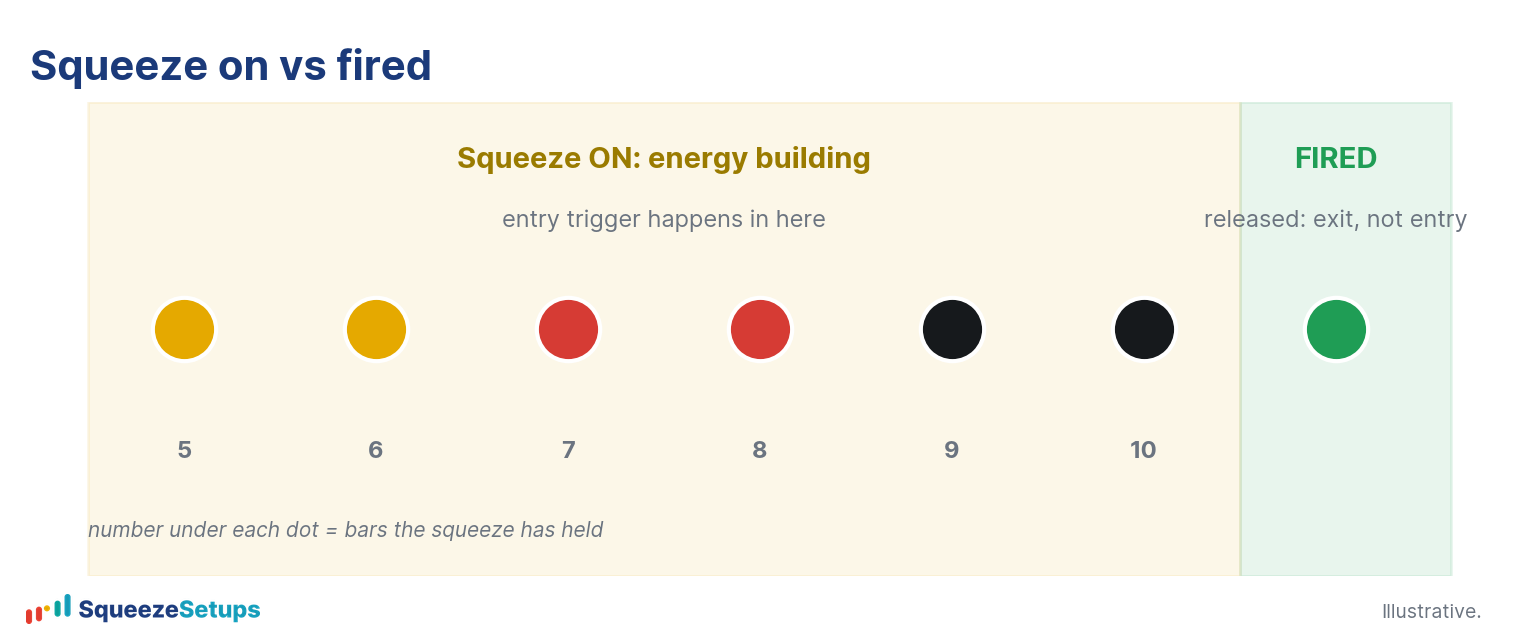
So when a beginner sees a fresh green dot and reads it as “go,” they have it backwards. They are buying the moment the stored energy gets released, which is frequently late.
Why buying the green dot is late
Many of the strongest moves never give you a comfortable entry. Our 22-year backtest across 614 stocks found that about 46% of long signals never pulled back even 1 ATR after the trigger. And those runners won about 92% of the time, a number that held steady across every era we tested.
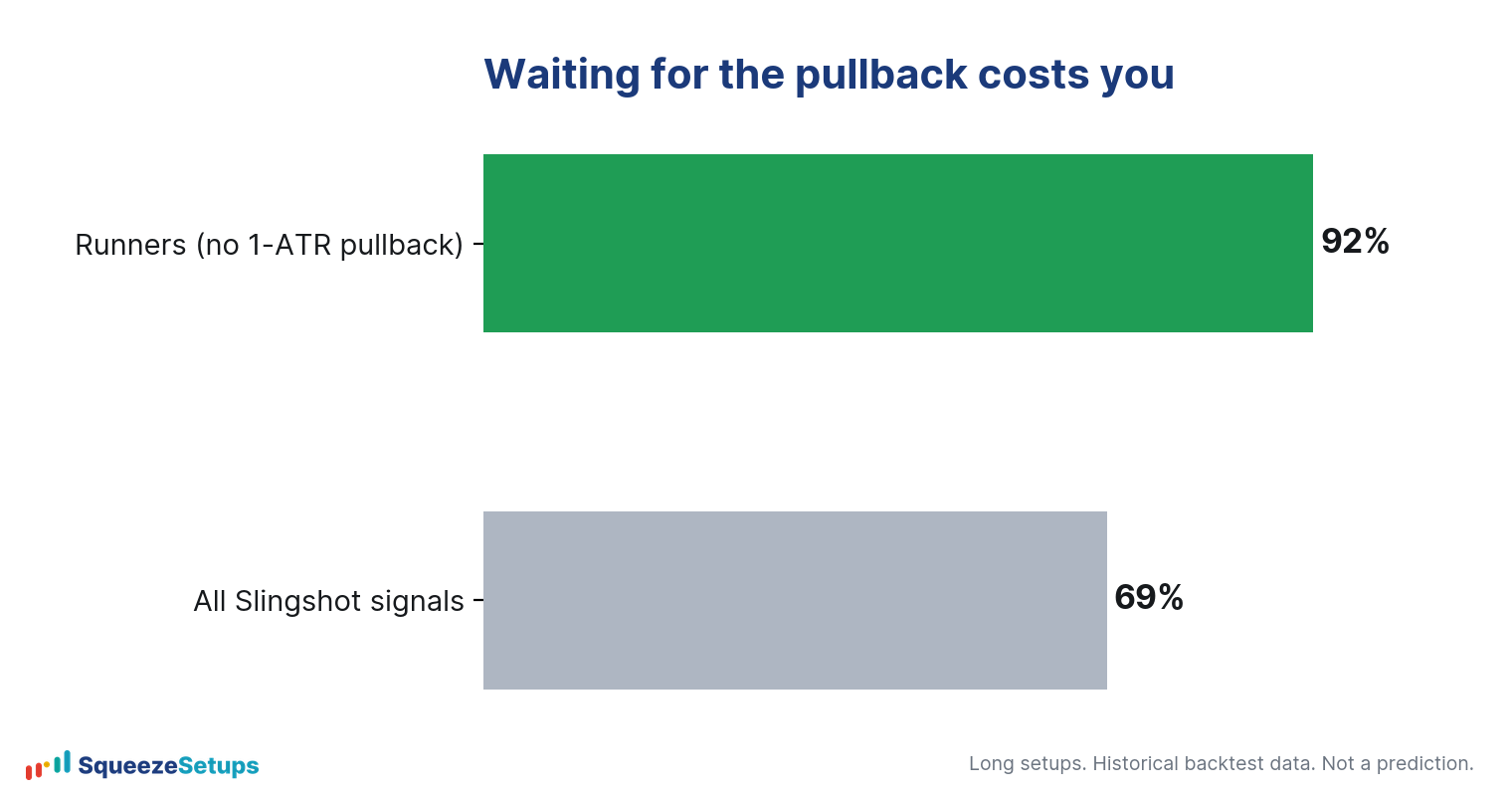
If almost half of the best trades take off immediately and never look back, then waiting for the squeeze to visibly fire (the green dot) means you are showing up after the move you wanted has already happened. The average adverse excursion across signals was only about 1.6 ATR, so even the trades that did wobble did not wobble much. The move was decided early, while the dots were still colored.
The green dot confirms the move, but confirmation is not an edge. By the time price has confirmed, the market has already priced in what you were waiting to see.
How our setups time it instead
Both of our setups enter while the squeeze is still on, not after it fires. The trigger is what you act on; the fire is what you exit on.
- Slingshot Squeeze: enter when momentum turns up from below zero while the squeeze is still on, in a stacked uptrend (EMA 8 > 21 > 34), with Edge Signal confirmation.
- Squeeze Signal: a continuation entry, where momentum is already above zero and the compression tightens a tier, again while the squeeze is on, with Edge Signal confirmation.
In both cases the entry happens during the colored-dot phase. The green fire is the release we are positioned for, the thing we wait through, and then it is our cue to be done. On the board this shows up plainly: a gold arrow marks a Slingshot Squeeze trigger and a cyan arrow marks a Squeeze Signal trigger, and the Status column moves a row from “in squeeze” to “FIRED” as the dot turns green.
Does it actually pay better than waiting?
Yes, and the bare-squeeze numbers make the contrast clear. Waiting for the squeeze to mature does not rescue it:
- Bare squeeze, no trigger: about 53.9%, no better than a random trading day at 53.7%.
- Waiting for five dots: about 54.1%.
- Buying the first green dot: about 54.8%.
Those are all close to a coin flip.
The triggered setups, entered while the squeeze is on, perform differently:
| Entry approach | Win rate | Avg per trade |
|---|---|---|
| Random trading day | ~53.7% | baseline |
| Bare squeeze | ~53.9% | no edge |
| Buy the first green dot | ~54.8% | no edge |
| Slingshot Squeeze (daily) | 69.1% | +0.93% |
| Squeeze Signal (daily) | 67.4% | +0.71% |
The Slingshot Squeeze on the daily timeframe won 69.1% across 5,852 trades at +0.93% average per trade, era-stable from 66.8% to 70.9%. The Squeeze Signal on the daily timeframe won 67.4% across 4,496 trades at +0.71% per trade. The edge lives in the trigger taken while the dots are colored, not in the green dot itself. (The Squeeze Signal is validated on the daily timeframe only; the intraday version is still in progress.)
None of this is a sure thing. One trade in three still lost, and these are historical backtests before commissions and slippage. But the lesson is consistent: the green dot is where the work pays off, not where the work begins.
Please note: This research is based on historical backtest data. It is NOT a prediction, and it is NOT financial advice.
Related: What is the squeeze?, The Slingshot Squeeze explained, Why a bare squeeze has no edge