Risk, Sizing, and Journaling
Goal: Trade the squeeze setups with a fixed-risk position size, a stop tied to the squeeze itself, and a journal entry for every trade.
You need: An account, the Trade Plan and Trade Journal templates from your member downloads, and a trigger you actually want to take (a gold Slingshot Squeeze arrow or a cyan Squeeze Signal arrow on the Squeeze Board).
The edge in our backtest comes from taking the same setup, the same way, thousands of times. The daily Slingshot Squeeze won 69.1% over 5,852 trades and the daily Squeeze Signal won 67.4% over 4,496 trades, but those numbers assume a fixed position on every trade. Size each trade differently, skip the losers you do not like the look of, or move your stop on a whim, and you are no longer trading the thing we measured. This doc covers the three pieces of discipline that keep your trading close to the backtest: sizing by risk, placing the stop, and journaling.
Why size by fixed risk (R) instead of fixed shares?
Fixed risk means you decide in advance how much money you are willing to lose if a trade goes against you, and you call that one unit “R”. Every trade risks the same R, whether the stock is $30 or $300. That one rule makes every trade in your log comparable. A win is “+2R”, a loss is “-1R”, and your results read the same units as our backtest expectancy.
Pick an R you can take many times without flinching. A common starting point is a small fraction of account equity per trade. The exact percentage is your call and your risk tolerance, not ours. What matters is that it stays constant, because the backtest’s +0.93% average per Slingshot trade only compounds to roughly +5,460% cumulative when the position size is consistent. The result comes from sizing the same way on every trade, not from any single trade.
Once you have chosen R, share count falls out of it:
| Input | Example |
|---|---|
| Risk per trade (R) | $200 |
| Entry price (on the trigger) | $50.00 |
| Stop price | $47.50 |
| Risk per share (entry minus stop) | $2.50 |
| Shares = R / risk per share | $200 / $2.50 = 80 shares |
The wider your stop, the fewer shares you buy, so the dollar loss at the stop is the same R every time. You never size by “how many shares feel right”. You size by where the stop is.
Where does the stop go relative to the squeeze?
Both setups have the same structural rule: you enter on the trigger while the squeeze is still on, and the green fire is the exit, not the entry. That tells you where the stop belongs. The trade thesis is “momentum is turning up inside live compression, in a stacked uptrend.” The stop sits at the price that says that thesis is wrong.
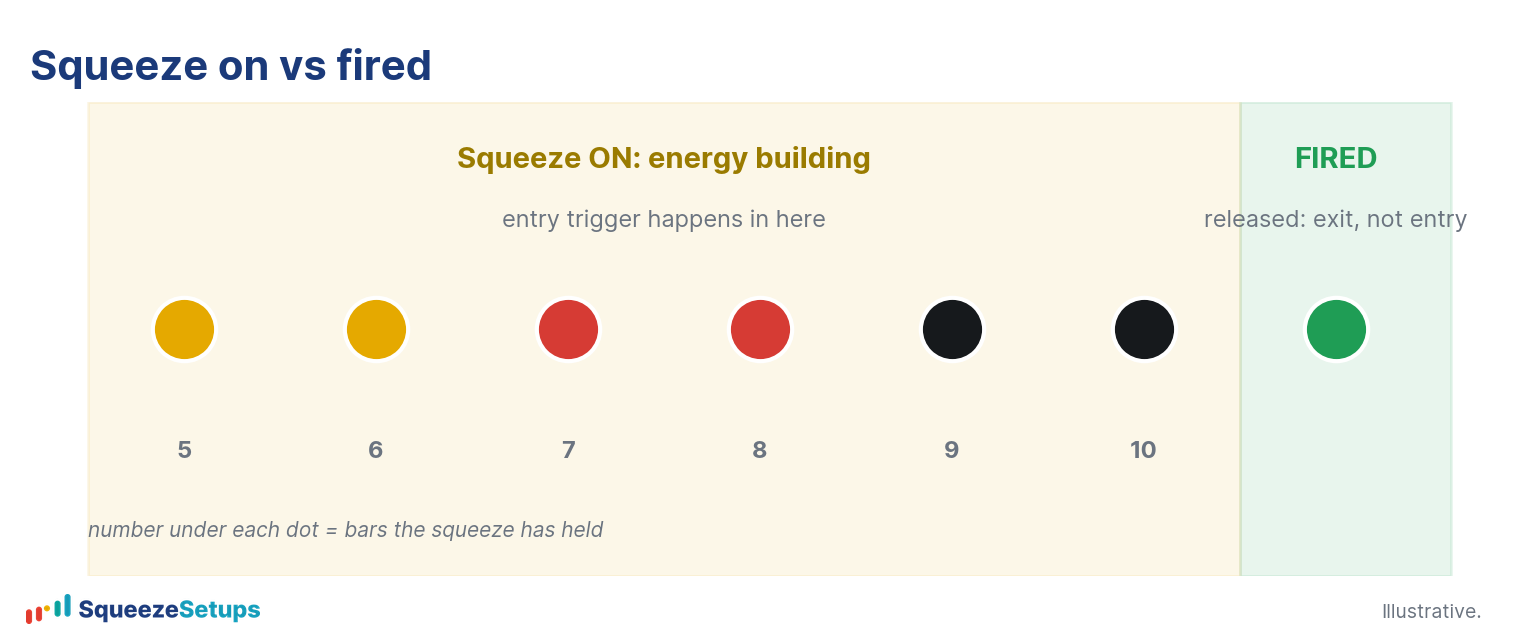
Practical placement: anchor the stop a bit below the trigger candle’s structure, for example below the low of the trigger candle or below the nearest swing low that the move came from. Then size to that distance using the table above. Sizing by risk means a slightly wider, more sensible stop does not cost you anything except share count, so you do not need to crowd the stop right under the entry to “afford” the trade.
Two things our backtest data should change about how you hold the trade:
- Do not yank the stop forward too fast. The average adverse excursion on long signals was about 1.6 ATR. Trades that go on to work often dip against you first. A stop placed inside normal noise gets you shaken out of winners.
- Let runners run. About 46% of long signals never pulled back a full 1 ATR, and those runners won roughly 92% in the backtest, era-stable. If a trade goes straight up and the board shows a runner chip, that is the population you most want to stay in, not the one to take quick profits on.
One honest caveat: one trade in three still lost, even at a 69% win rate. The stop is not a suggestion. Taking the full -1R loss when the thesis breaks is exactly what the backtest did, and it is what keeps your losers small enough for the winners to pay for them.
A note on direction
We are long-biased by default, and sizing is part of why. The short Slingshot won 60.3% but carried negative expectancy of about -2.0% per trade. A good win rate with negative expectancy means your sizing discipline cannot save you: you would be risking real R on a bet that loses money on average. Shorts only earned their place on names with a positive per-symbol short record in the Backtester. If you have not checked that record, do not short it.
How to journal every trade
The journal is where you find out whether you are actually trading the setup or trading your mood. Your member downloads include a Trade Plan and a Trade Journal template (in My Downloads on your membership). Use the Trade Plan before the trade and the Trade Journal after it.
Before you enter, the Trade Plan should capture the decision while it is honest, before the outcome can rewrite your memory:
- Symbol, setup (Slingshot Squeeze or Squeeze Signal), and the trigger timeframe.
- The three pillars at entry, straight off the symbol drawer: is the trend stacked (EMA 8>21>34), how many timeframes are in confluence (the TFs count, e.g. 5/5), and what the 22-year backtest record for this symbol says (n, Win %, Net %, Exp).
- Entry price, stop price, risk per share, R in dollars, and the resulting share count.
- Extension (Ext, how far price is above its mean in ATRs) and Market Pulse, so you can later see whether entering while extended hurt you.
After the trade closes, the Trade Journal records the result in R, not just dollars:
- Exit price and exit reason: green fire, stop hit, or runner you let go.
- Result in R (+2.0R, -1.0R, and so on) and hold time in days. For reference, daily holds averaged about 13 days for Slingshot and 15 for Squeeze Signal.
- Did you follow the plan? A simple yes/no. Over enough trades, this column is the most valuable thing in the journal.
Once you have 20 or 30 entries, the journal answers questions the backtest cannot answer about you: are your “no, I did not follow the plan” trades your worst ones? Are you cutting runners early? Are you sizing consistently? That feedback loop is what lets you trade the setup the way the backtest measured it.
Squeeze Setups is an educational research tool, not financial advice.
Related: The Daily Routine, Trade Along: One Setup, Start to Finish, How to Trade the Squeeze