The Squeeze Signal, Explained
Key takeaways
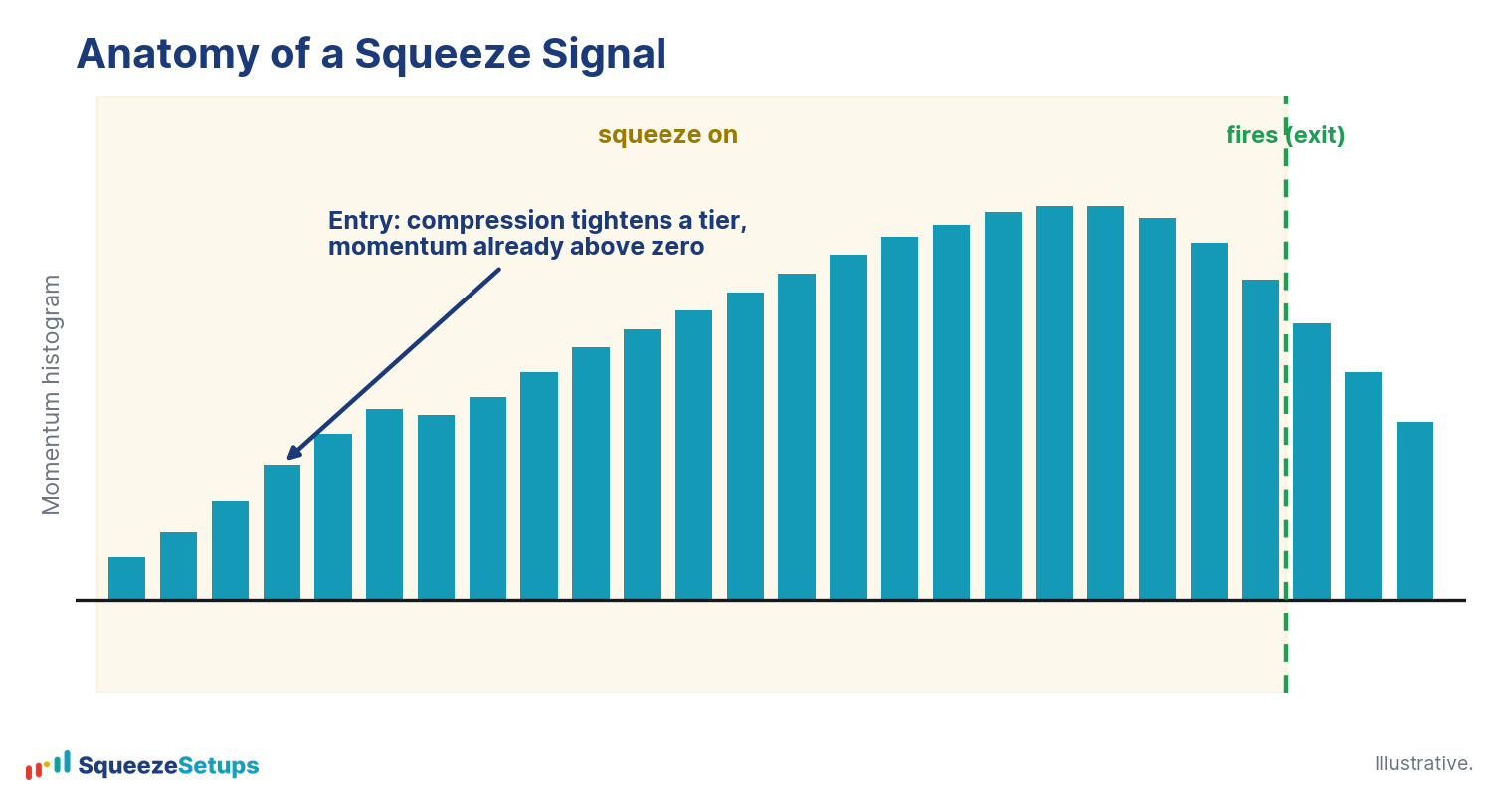
- The Squeeze Signal is a continuation entry: the compression tightens a tier while momentum is already above zero, in a stacked uptrend.
- On the daily timeframe it won 67.4% across 4,496 trades over 22 years, average hold about 15 days.
- The win rate held between 64.9% and 71.3% in every five-year era from 2004 to 2026.
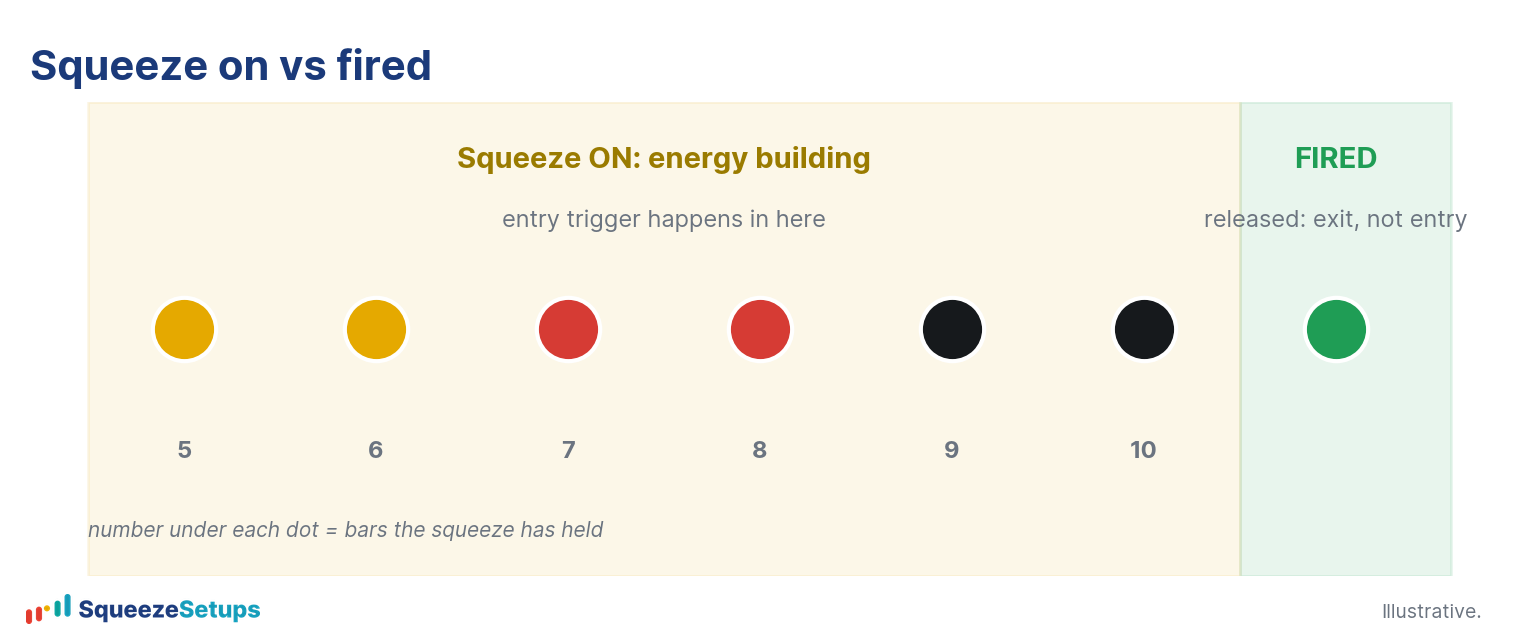
- Like the Slingshot, you enter on the trigger while the squeeze is on, and you exit when the squeeze fires.
The Squeeze Signal is our second setup. Where the Slingshot times a turn from below zero, the Squeeze Signal is a continuation: momentum is already above zero and the squeeze tightens a tier underneath it while price already leans your way. On the daily timeframe it won 67.4% of the time across 4,496 trades over 22 years in our backtest.
What is the Squeeze Signal?
The dots come in tiers, by how tightly the market is compressed: a looser tier and a tighter tier. The Squeeze Signal looks for the compression stepping inward by one tier across two bars, from looser to tighter, while momentum is already above zero. Compression is deepening underneath a move that is already pointed up.
What has to line up?
Like the Slingshot, the Squeeze Signal needs several things on the same bar:
- The squeeze is tightening a tier. The prior bar was in a looser squeeze tier and the current bar has stepped to a tighter one.
- Momentum is already above zero. The market is leaning your way before you enter.
- The trend is stacked up. 8 over 21 over 34 over 50 over 200.
- The close is at or above the 34 EMA.
- The Edge Signal confirms, the same confirmation layer the Slingshot uses.
Where the Slingshot times the turn, the Squeeze Signal times the re-tightening inside a move that is already underway. The two are built to complement each other, which is why we run both.
When do you enter and exit?
The same model as the Slingshot:
- Enter on the trigger while the squeeze is still on, that is your starter.
- Add on a pullback if one comes.
- Exit when the squeeze fires, the green dot.
What is its track record?
On the daily timeframe, the Squeeze Signal produced this record in our 22-year backtest:
| Metric | Daily, 2004 to 2026 |
|---|---|
| Win rate | 67.4% |
| Trades | 4,496 |
| Average hold | About 15 days |
| Average per trade | +0.71% |
| Cumulative, fixed position | About +3,188% |
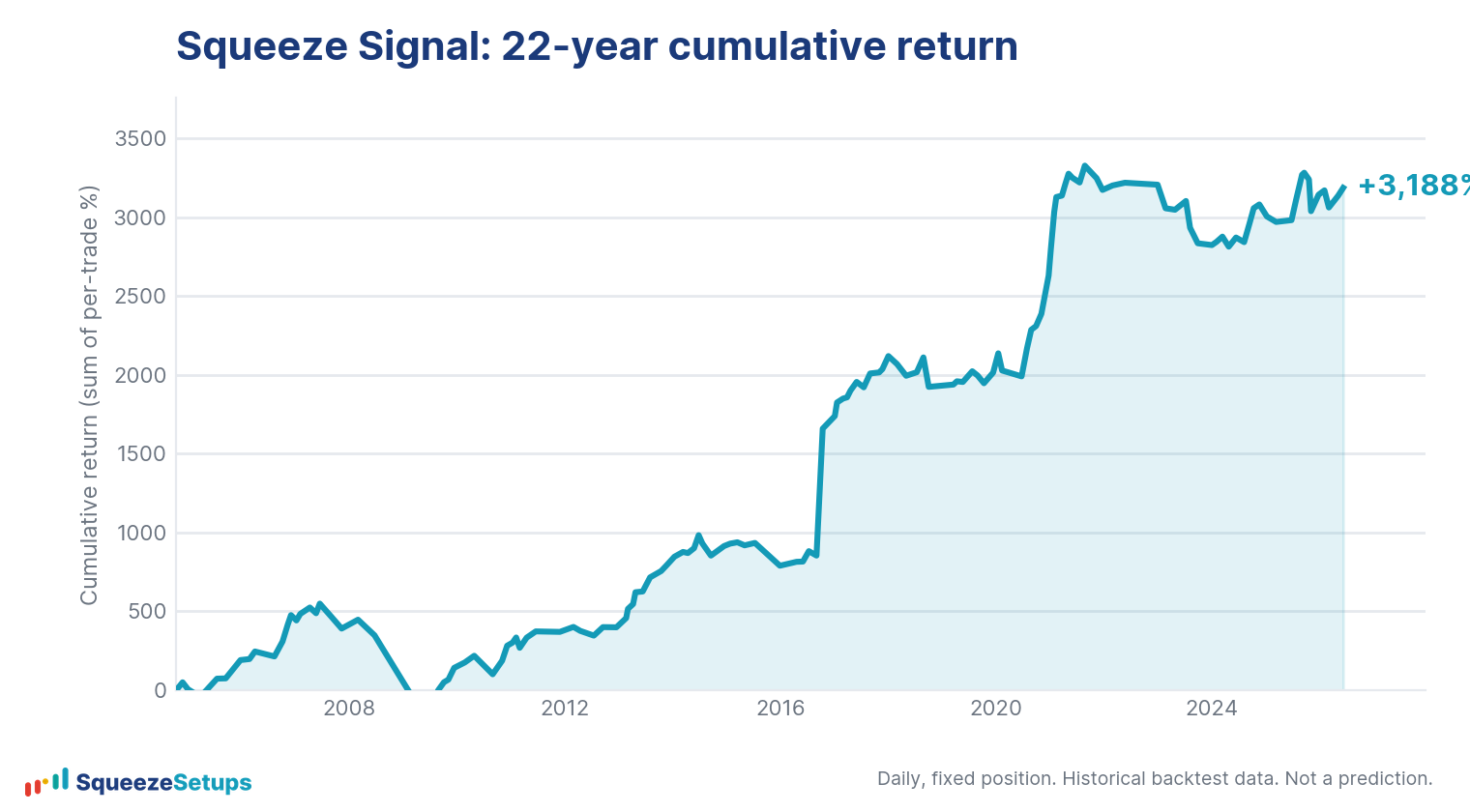
As with the Slingshot, the record holds up over time. The daily win rate stayed between 64.9% and 71.3% in every five-year era we tested. It is validated independently of the Slingshot, on its own trades.
What it does not promise
A few honest limits to keep in mind:
- About a third of trades still lost in our sample.
- The figures are from historical backtests, not a forecast, and they are before commissions and slippage.
- The setup is long-biased.
- It is currently validated on the daily timeframe, with intraday validation in progress.
A win rate is an edge across many trades, not a promise on the next one.
Please note: This research is based on historical backtest data. It is NOT a prediction, and it is NOT financial advice.
Related: The Slingshot Squeeze, explained · Why a bare squeeze has no edge · What is the Squeeze?