Slingshot Squeeze vs Squeeze Signal: 10,515 Trades, Head to Head
FAIL: error: no such post
Key takeaways
- The Slingshot wins the head-to-head: across 22 years of daily backtests, it won 68.4% of 6,008 long trades at a 1.33 profit factor. The Squeeze Signal won 67.4% of 4,507 at 1.24.
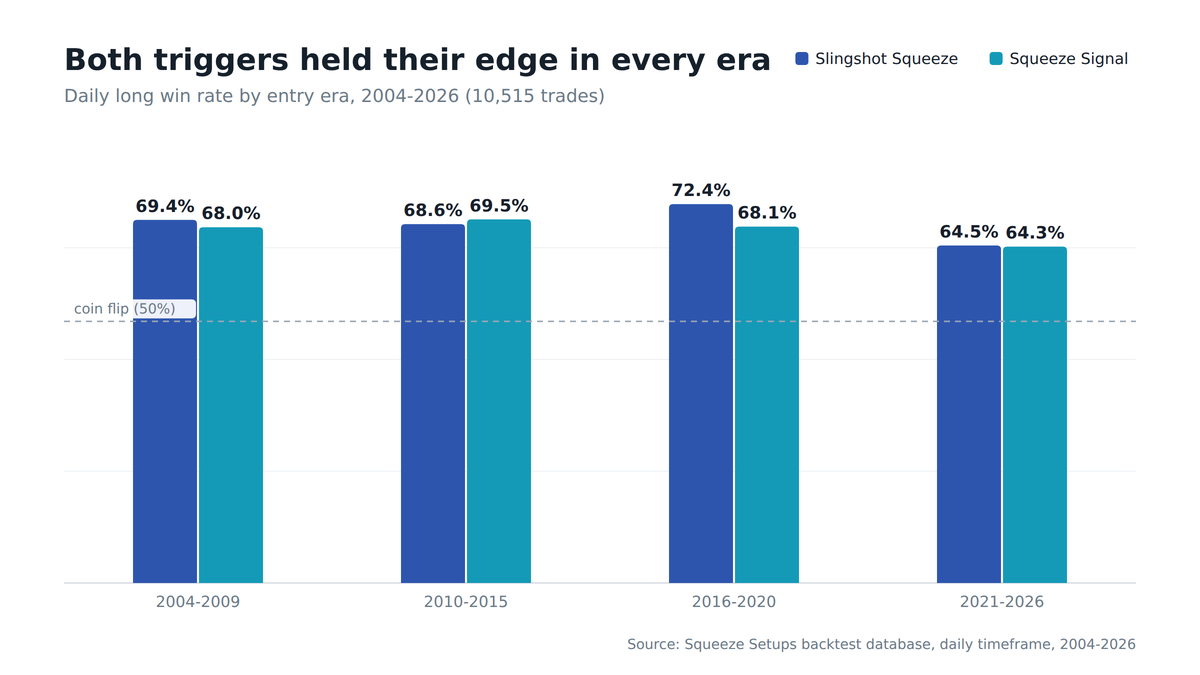
- Both edges held in every era: both setups stayed between 64% and 72% win rate in every era we tested, from 2004 to today. Neither edge belongs to one market regime.
- The Slingshot pays more, faster: +0.91% average per trade vs +0.71%, and it resolved slightly faster, 13.3 days vs 14.6.
- Both are long edges: the short versions of each lose money over the same 22 years, which is why the system is long-biased.
We run two trigger setups on the daily timeframe: the Slingshot Squeeze and the Squeeze Signal. Members ask which one is better often enough that we decided to settle it with data.
So we pulled every daily trade from the backtest database, 2004 through today, and put the two side by side. Same universe, same data, same exit logic.
The head-to-head numbers
| Setup (daily, long) | Trades | Win rate | Avg return | Profit factor | Avg duration |
|---|---|---|---|---|---|
| Slingshot Squeeze | 6,008 | 68.4% | +0.91% | 1.33 | 13.3 days |
| Squeeze Signal | 4,507 | 67.4% | +0.71% | 1.24 | 14.6 days |
On every column, the Slingshot is a notch ahead:
- Win rate: one point more, 68.4% vs 67.4%.
- Per trade: 20 basis points more, +0.91% vs +0.71%.
- Speed: about a day less time in the trade, 13.3 days vs 14.6.
- Volume: it is also the busier setup, producing roughly a third more signals over the same 22 years.
That said, a 1.24 profit factor with 4,507 trades behind it is not a loser you discard. It is a second, independent long edge.
The honest summary is not Slingshot beats Squeeze Signal. It is that the Slingshot earns its rank as the primary trigger, and the Squeeze Signal earns its place as the confirming setup.
The consistency test: four eras, one answer
A single 22-year average can hide a strategy that made all its money in one lucky stretch. So we split both setups into four eras and asked the same question we started with when we first tested whether the squeeze works at all: did the edge show up?
| Era | Slingshot win rate | Slingshot avg | Squeeze Signal win rate | Squeeze Signal avg |
|---|---|---|---|---|
| 2004-2009 | 69.4% (1,216) | +0.55% | 68.0% (872) | +0.17% |
| 2010-2015 | 68.6% (1,620) | +0.54% | 69.5% (1,177) | +0.54% |
| 2016-2020 | 72.4% (1,419) | +2.33% | 68.1% (1,169) | +1.64% |
| 2021-2026 | 64.5% (1,753) | +0.34% | 64.3% (1,289) | +0.36% |
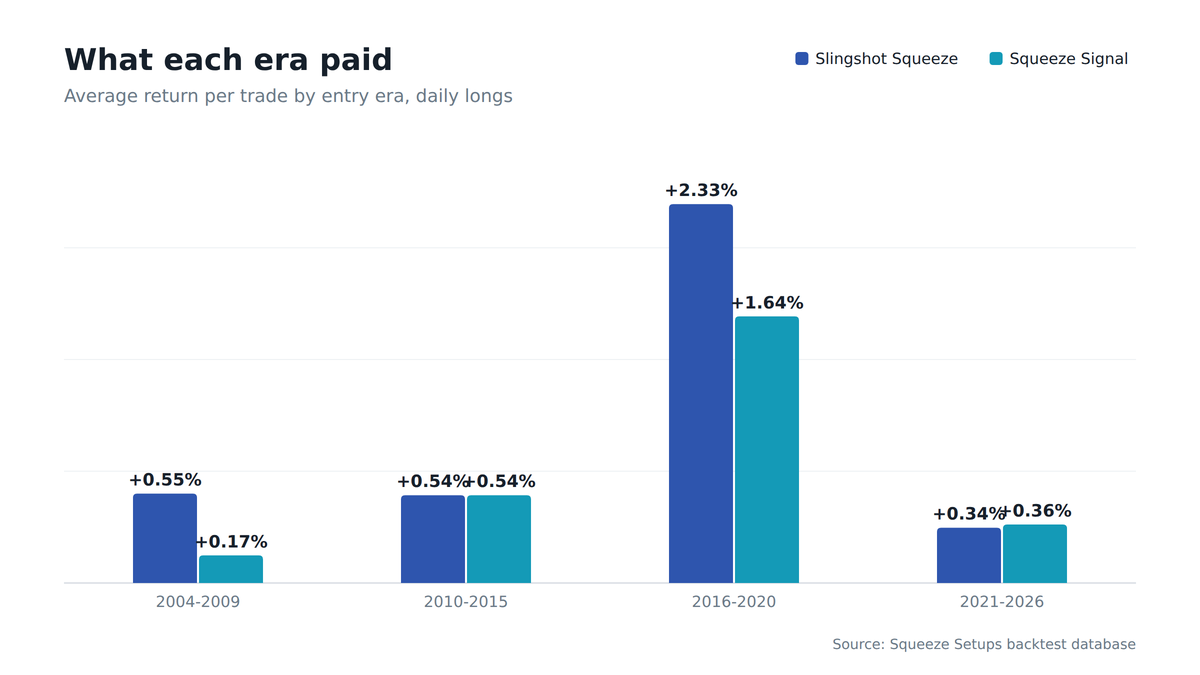
Every cell stays in the 64% to 72% band. That includes the financial crisis years, the zero-rate melt-up, the 2020 crash and recovery, and the current era.
Expect the lean number
The best stretch for both was 2016-2020, and the leanest is the most recent era, which is worth knowing. The edge today looks like roughly 64%, not the 22-year headline.
We would rather you expect the lean number and be surprised by the good years than the reverse.
Why the short side is not here
Both setups have short versions, and we backtest them continuously. Over the same 22 years the Slingshot short won 60.1% of trades yet averaged a negative return per trade, and the Squeeze Signal short finished with a 0.98 profit factor, which is a coin flip after costs.
Winning often and still losing money is what an asymmetric market does to short sellers over two decades. We keep publishing those numbers, and they keep telling us the same thing: these are long edges.
The full study on that is in The Short Side: Why We Are Long-Biased.
How to use the two setups together
In practice the ranking matters less than the pairing. On the platform, the Slingshot is the trigger we feature, and a symbol where both setups have a credible record is stronger evidence than either alone. That stacking logic matters because a bare squeeze on its own has no edge.
When you are choosing between two fresh signals, the 22-year tiebreakers are simple: the Slingshot resolves faster and earns more per trade, so equal setups favor it.
The fine print
One caution belongs on every backtest we publish:
- Historical, not live: these are historical signal studies on daily bars, not live fills.
- Your execution is yours: slippage, gaps, and position sizing are yours to manage, and no win rate promises the next trade.
- What the record does support: both triggers have shown a durable long edge across every market era since 2004, and the Slingshot has been the stronger of the two.
Keep reading
- Inside 10,515 Squeeze Trades: What Happens Between Entry and Exit
- Does Squeeze Tightness Matter? Yellow vs Red vs Black Dots
- The Squeeze Edge Held in Every Era (2004 to Today)
Frequently asked questions
Which squeeze trigger has the higher win rate, the Slingshot or the Squeeze Signal?
The Slingshot Squeeze won 68.4% of 6,008 daily long trades over 22 years, versus 67.4% of 4,507 trades for the Squeeze Signal. The Slingshot also carries the higher profit factor, 1.33 to 1.24. It is the stronger of the two on every column.
How many trades is this squeeze head-to-head based on?
10,515 daily long trades sit behind this comparison, spanning 2004 through today. That splits into 6,008 Slingshot Squeeze trades and 4,507 Squeeze Signal trades, run on the same universe, same data, and same exit logic.
Does the squeeze edge still work in recent years, or only in older data?
Both setups held between 64% and 72% win rate in every era tested since 2004. The leanest stretch is the current 2021-2026 era, near 64.5% for the Slingshot and 64.3% for the Squeeze Signal, so plan around roughly 64% rather than the 22-year headline.
Can you trade the squeeze on the short side?
The Slingshot short won 60.1% of trades yet still averaged a negative return per trade over 22 years, and the Squeeze Signal short finished at a 0.98 profit factor, a coin flip after costs. Both squeeze triggers are long edges; the short versions lose money.
How long does a squeeze trade take to resolve?
The Slingshot Squeeze resolved in 13.3 days on average, versus 14.6 days for the Squeeze Signal, across daily long trades since 2004. The Slingshot is roughly a day faster and pays more per trade, +0.91% versus +0.71%.
Should I use the Slingshot and the Squeeze Signal together or pick one?
The Squeeze Signal’s 1.24 profit factor across 4,507 trades makes it a second, independent long edge, not one to discard. Use the Slingshot as the primary trigger and the Squeeze Signal as confirmation; a symbol where both have a credible record is stronger evidence than either alone.