The Runner Finding: Most Big Moves Never Pull Back
Key takeaways:
- About 46% of long signals never pull back a full 1 ATR after the trigger. They keep running.
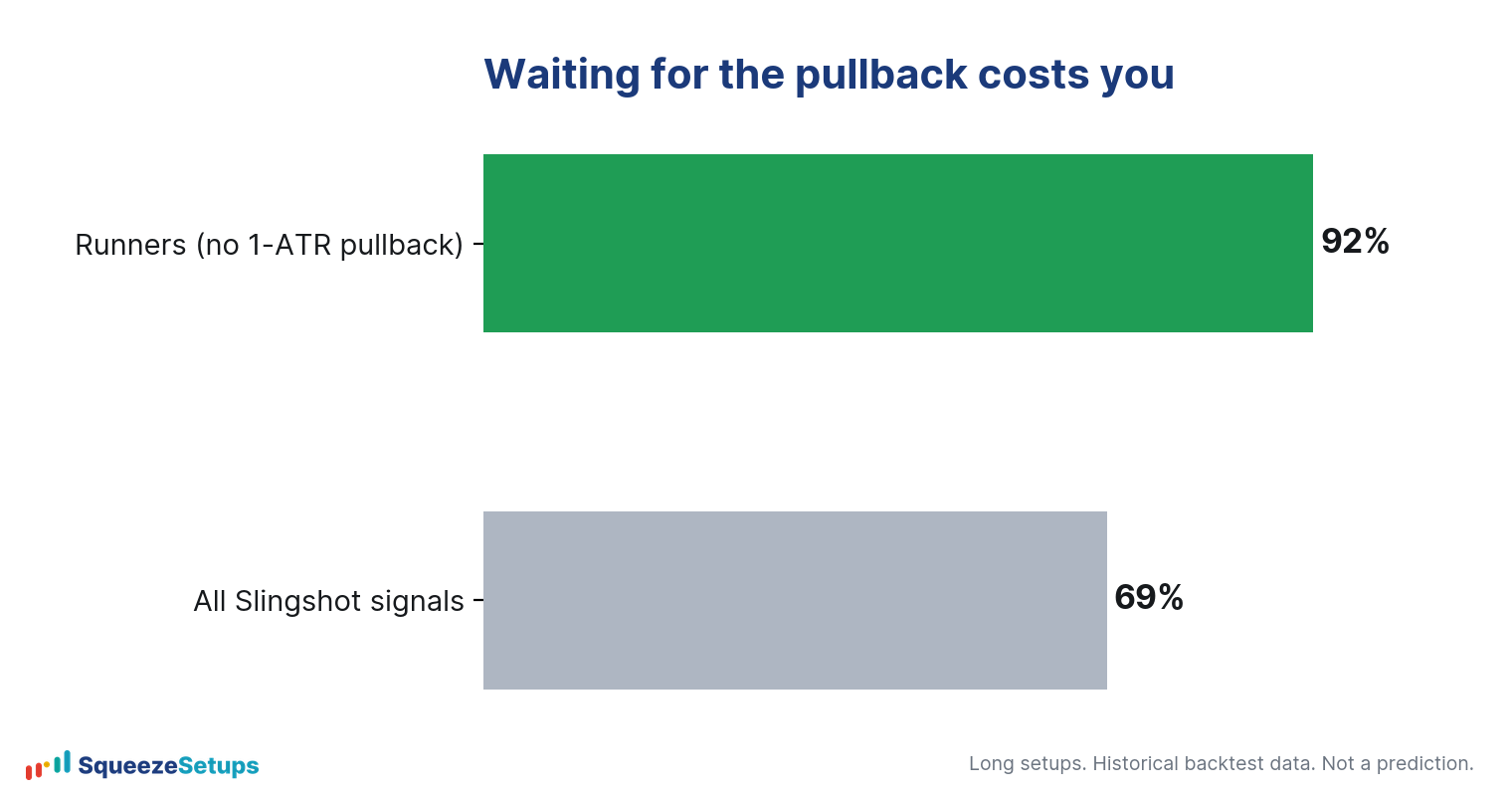
- Those runners won roughly 92% of the time, and that win rate held across all five eras of our 22-year test.
- The average adverse excursion across all long signals was about 1.6 ATR, so even the trades that do dip rarely dip far.
- Waiting for a clean pullback to enter systematically skips the best trades. Enter on the trigger, then add on a pullback if one comes.
One of the most common entry rules in trading is “wait for the pullback.” Let the move come back to you, get a better price, lower your risk. It sounds disciplined.
But when we measured it against our 22-year study of squeeze signals, the result went the other way. The strongest moves are often the ones that never give you a pullback to wait for.
We call this the runner finding, and it is the single biggest reason we tell traders to enter on the trigger rather than on a dip.
What is a runner?
We define a runner as a long signal where, after the trigger fires, price never retraces a full 1 ATR (Average True Range) against the entry before the trade resolves. The trade goes green and stays green. It does not hand you a second, cheaper entry, because it never comes back.
When we tagged every long Slingshot Squeeze and Squeeze Signal trade in our 614-stock, 2004 to 2026 universe, about 46% of them were runners. That is nearly half of all signals.
If your plan is to scale in only on a 1 ATR dip, you sit out almost half the trades the system finds, and not a random half.
How well did runners do?
The runners, the trades that never gave a pullback, won about 92% of the time. That is far above the roughly 69% win rate of the daily Slingshot Squeeze overall, and it is not limited to one bull market.
The runner win rate stayed stable when we split the sample into five separate eras spanning the full 22 years.
A trade that never pulls back is under steady buying pressure. The lack of a pullback tells you something: demand is strong enough that sellers never drag price back a full 1 ATR.
How far do the others pull back?
So what about the other 54%, the trades that do dip? They do not dip far. Across all long signals, the average adverse excursion, the worst drawdown a trade saw before resolving, was about 1.6 ATR.
That is the average for the whole population, runners included, so the typical pullback trade is shallow, not a deep retrace.
Most signals either never pull back at all, or pull back only modestly. The deep pullback that a wait-for-it entry is hoping for is the exception, not the rule.
| Group | Share of long signals | Behavior after trigger | Win rate |
|---|---|---|---|
| Runners | ~46% | Never pull back 1 ATR | ~92% (era-stable) |
| Pullback trades | ~54% | Pull back, avg adverse excursion ~1.6 ATR | Below the runner group |
Why waiting for a pullback costs you
A pullback entry rule does not just delay your entry, it filters your trades, and it filters out the wrong ones. The trades it removes from your book are disproportionately the runners, the 92%-winners.
The trades it keeps are the ones that pulled back, which is a weaker group on average. You end up trading the leftovers.
What mechanical pullback entries actually returned
This is the same lesson we found when we tested mechanical pullback entries directly. The numbers:
- Buying a pullback to the 34 EMA won about 45.5% of the time.
- Buying a pullback to the 50 SMA won about 44.4%.
- Both were worse than a random day in the market (53.7%).
Waiting for price to come back to a moving average was not a discipline, it was a way to systematically buy weakness. This fits the runner finding: the best moves never reach those averages.
On vs Fired: timing the trigger
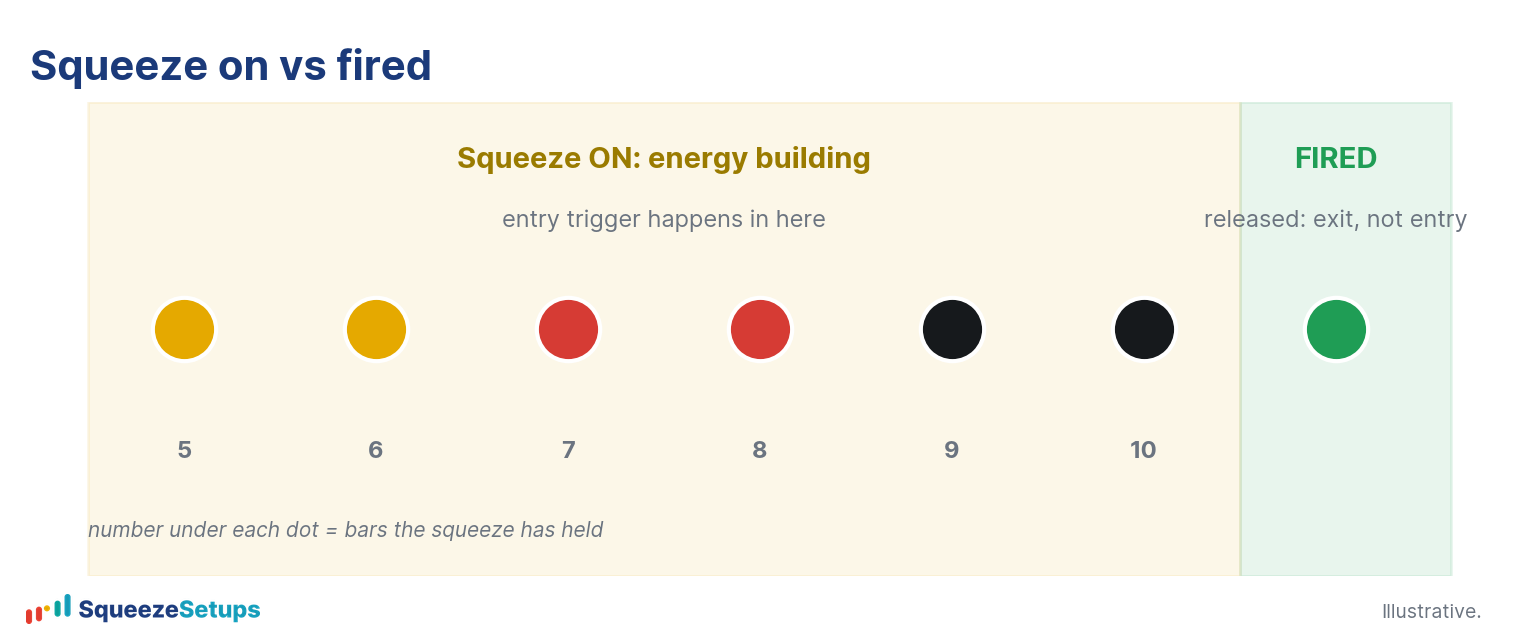
If you are going to enter on the trigger, it matters that you understand what the trigger is. The squeeze being ON is the setup, the entry window. The green “Fired” dot is the exit, not the entry. By the time a signal fires, the runner has often already done most of its work.
On the Squeeze Board, a gold arrow marks a Slingshot Squeeze trigger and a cyan arrow marks a Squeeze Signal, both with the timeframe shown.
When the Status reads “in squeeze” with a fresh trigger, you are inside the window. Once it reads “FIRED,” the move is already underway, and chasing it is worse than acting on the trigger was.
What to actually do with this
The runner finding does not say “never use a pullback.” It says do not make the pullback a condition of entry. The practical rule we use:
- Enter on the trigger while the squeeze is still on. This is the only way to be in the ~46% of trades that never come back.
- Add on a pullback if one comes. Treat a shallow dip (recall the ~1.6 ATR average) as a chance to size up, not as your first ticket in.
- Do not wait for the green dot. The fire is the exit. If you only act once a signal has fired, you are buying the move late.
One honest caveat applies to all of this. These are historical backtests across 614 names, measured before commissions and slippage, and one trade in three in the broader sample still lost.
A 92% runner win rate is a strong tendency, not a certainty on any single ticker. But the asymmetry is large and it has been stable for two decades, and it points firmly in one direction: be in early.
Please note: This research is based on historical backtest data. It is NOT a prediction, and it is NOT financial advice.
Frequently asked questions
What percentage of squeeze signals never pull back?
About 46% of long signals in our 614-stock, 2004 to 2026 test never retraced a full 1 ATR after the trigger. Nearly half of all signals keep running and never hand you a cheaper second entry.
Do trades that never pull back win more often?
Yes. Runners, the trades that never pull back a full 1 ATR, won about 92% of the time. That is well above the roughly 69% win rate of the daily Slingshot Squeeze overall.
Should you wait for a pullback to enter a squeeze trade?
No. Buying a pullback to the 34 EMA won about 45.5% of the time and the 50 SMA about 44.4%, both worse than a random day at 53.7%. Waiting for a moving average systematically buys weakness.
How far do squeeze trades typically pull back?
About 1.6 ATR. That is the average adverse excursion, the worst drawdown before resolving, across all long signals, runners included. Most trades either never pull back or dip only modestly, so a deep retrace is the exception.
Is the squeeze being “on” the entry or is the “fired” dot?
The squeeze being on is the entry window. The green fired dot is the exit, not the entry. By the time a signal fires, a runner has often already done most of its work, so chasing the fire buys late.
Did the runner win rate hold across market cycles?
Yes. The roughly 92% runner win rate stayed stable across five separate eras spanning the full 22 years, from 2004 to 2026, not just a single bull market.
Related: The short side: why we are long-biased, Backtesting the squeeze, 22 years per symbol, Squeeze expectancy by timeframe