Inside 10,515 Squeeze Trades: What Happens Between Entry and Exit
FAIL: error: no such post
Key takeaways
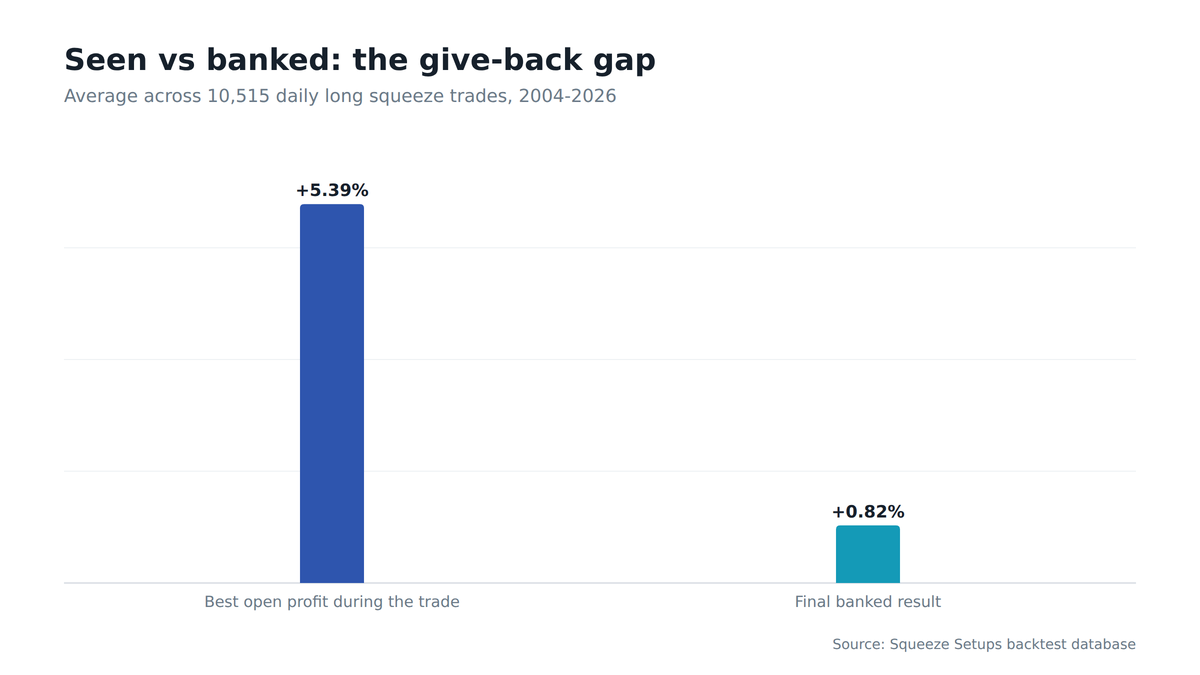
- Best vs banked: across 10,515 daily long squeeze trades since 2004, the average trade touched +5.4% at its best point but closed at +0.8%. Most of what the market offers, it also takes back.
- Losers were green first: 90.3% of losing trades were profitable at some point before closing red. Nearly 43% of losers saw at least +2%.
- +5% is a milestone: once a trade reaches +5%, history is strongly on its side: 87.4% of those trades closed positive and 67.2% held onto +5% or more at the exit.
- Speed is health: winners resolved in 11.5 days on average. Losers dragged on for 19. On the daily squeeze, time itself is information.
Every backtest we publish reports the finish line: win rate, average return, profit factor. This study is about everything before the finish line.
We went back through 10,515 daily long trades from our two triggers, the Slingshot Squeeze and the Squeeze Signal, from 2004 through today. If you want the finish-line numbers first, start with our 22-year study of whether the squeeze actually works.
For each trade we measured what happened between entry and exit: its best point, its worst dip, and how long it took to resolve.
The gap between best and banked
The average trade in the study reached +5.4% at its most favorable point. The average trade closed at +0.8%.
That 4.5-point gap is not a flaw in the setup. It is what an honest look inside almost any strategy shows: the market offers open profit, and most of it is not captured by any fixed exit rule.
The distribution behind those averages is the useful part:
- +3% is common: about 42% of all trades saw at least +3% at some point.
- +5% is a milestone: roughly one in four trades reached +5%.
- +5% rarely collapses: 87.4% of those trades still closed profitable, and two thirds banked +5% or better at the exit.
The uncomfortable one: losers that were winners first
Of the 3,369 losing trades in the sample, 90.3% were green at some point before they closed red. The average loser touched +2.5% open profit somewhere along the way, and 43% of losers saw at least +2%.
Read that carefully, because it cuts both ways. It would be easy to conclude you should grab every +2% the moment it appears.
But the winners in this same sample averaged +6.8% at their peak. Cutting everything at +2% would amputate the exact trades that pay for the system, the same fast movers we documented in the runner finding.
The honest lesson is narrower: a small open gain is not a resolved trade. The squeeze thesis is either still working or it is not, and the numbers below give you a better clock for judging that.
Time is a signal
Winning trades resolved in about eleven and a half days. Losing trades hung around for nineteen.
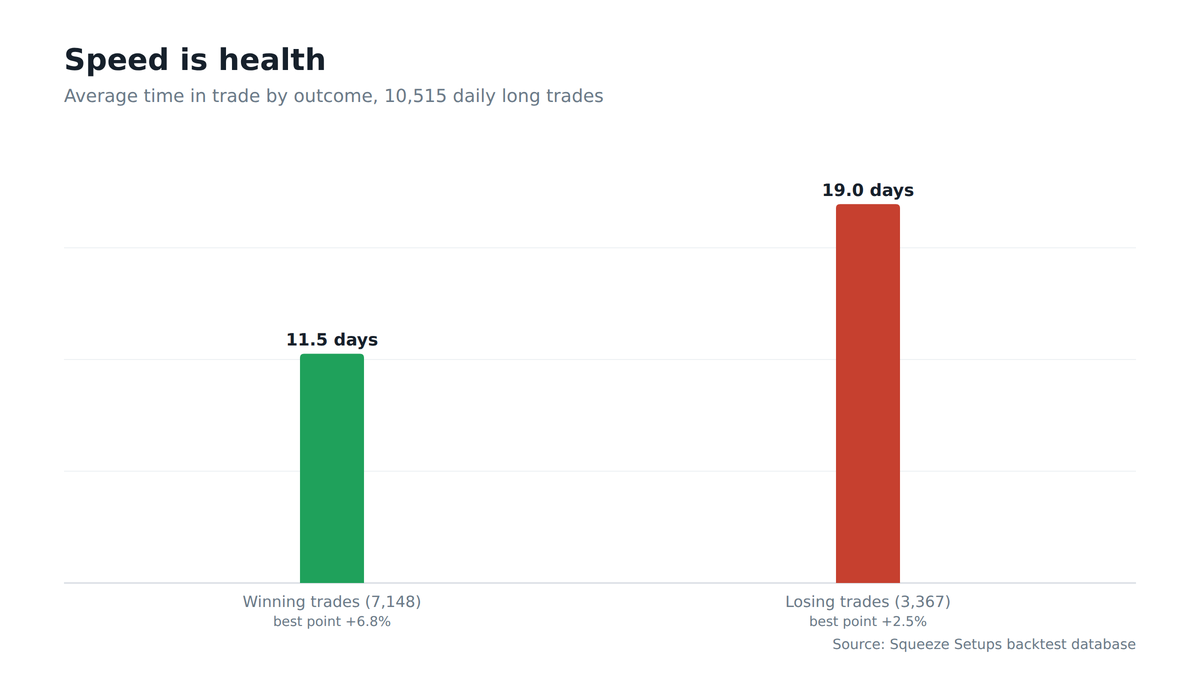
| Outcome | Trades | Avg time in trade | Avg best point |
|---|---|---|---|
| Winners | 7,148 | 11.5 days | +6.8% |
| Losers | 3,367 | 19.0 days | +2.5% |
That is a 65% longer hold for the trades that end up hurting you, and it matches what the squeeze is mechanically: a volatility release. When the release works, it works quickly, and the first dip tends to arrive around day 3.
A trade that has gone three or four weeks without paying is not early. It is statistically behaving like a loser, and it is also holding your capital hostage while fresher squeezes fire elsewhere.
What we do with this
Three practical rules fall out of this study:
- Respect the +5% line: once a trade gets there, the odds of it closing red drop to about one in eight, so there is no need to panic-sell strength.
- A first green print is not success: most losers had one too.
- Watch the calendar as closely as the chart: give fast movers room and refuse to babysit stalls.
The system exit for these backtests closes each trade when the squeeze cycle completes, and that fixed rule leaves real money on the table. Where you can add value by discretion, the data says it is less in picking better entries and more in managing time.
Entry quality still matters, of course. If you want to sharpen that side, our tightness tier study shows how yellow, red, and black dots compare across 4,509 trades.
The fine print
- Historical, not live: these are daily-bar backtest studies, not live fills.
- Averages describe crowds: the numbers summarize thousands of trades, not your next one.
- Daily timeframe only: the anatomy differs on other timeframes, as our expectancy-by-timeframe study shows.
But 22 years and ten thousand trades of anatomy agree on one thing: on the daily squeeze, speed is health. The good ones do not make you wait.
Keep reading
- Slingshot Squeeze vs Squeeze Signal: Head to Head
- The Runner Finding: Most Big Moves Never Pull Back
Frequently asked questions
How much open profit does a squeeze trade give back before it closes?
Across 10,515 daily long squeeze trades since 2004, the average trade reached +5.4% at its best point but closed at just +0.8%, a 4.5-point gap. The market offers far more open profit than any fixed exit rule captures.
Do losing squeeze trades ever show a profit first?
90.3% of losing squeeze trades were green at some point before they closed red. Of the losers in the sample, the average one touched +2.5% open profit somewhere along the way, and 43% saw at least +2%. A first green print is not a resolved trade.
What are the odds after a squeeze trade reaches +5%?
87.4% of squeeze trades that touched +5% open profit went on to close positive, and two thirds banked +5% or better at the exit. Once a trade gets there, the chance of it closing red drops to about one in eight.
How long do winning versus losing squeeze trades take?
Winning squeeze trades resolved in 11.5 days on average, while losers hung around for 19.0 days, a 65% longer hold. On the daily squeeze, a trade that has gone three or four weeks without paying is statistically behaving like a loser.
What percentage of squeeze trades reach +3% or +5%?
About 42% of all squeeze trades saw at least +3% open profit at some point, and roughly one in four reached +5%. These milestones come from measuring the best point of each of the 10,515 daily long trades in the study.
Should you take profits at +2% on a squeeze trade?
Winners in the sample averaged +6.8% at their peak, so cutting everything at +2% would amputate the fast movers that pay for the system. While 43% of losers also saw +2%, a small open gain is not proof the trade is resolved.